Private fund risk: More than cash flow timing
Author:

William Morokoff
Global Head of Research, SimCorp
Some may argue private fund risk is purely a liquidity problem, e.g. fund capital calls. However, our research shows that fund distributions correlate meaningfully with public equity returns across Private Equity, Venture Capital, Debt and Real Estate and a factor-based risk model can help investors see real, measurable market risk.
Fund distributions move with public markets and cash flow timing should factor this in
Market risk for private fund portfolios is in fact also relevant, both for liquidity management and asset allocation.
If a market falls but no one is around to trade it, do investors incur a loss? This philosophical question is at the heart of risk management for closed-end private fund portfolios. While a limited, albeit growing secondary market exists, sellers often must take large haircuts with trading driven by liquidity rather than for portfolio rebalancing or hedging purposes. As the ultimate buy-and-hold position, are private funds subject to market risk and, if the risk could be measured, what could be done about it?
Some have argued that market risk for private funds is a red herring and that the real risk lies in cash flow management to ensure an optimal allocation to funds balanced by a sufficient pool of liquid public market investments to fund the uncertain timing of capital calls. Severe but plausible public market drops coupled with unexpectedly large funding calls across the portfolio need to be managed to guarantee all obligations can be met.
Analyzing the risk associated with cash flow timing is indeed important. We argue here that market risk for private fund portfolios is in fact also relevant, both for cash flow liquidity management as well as for informing asset allocation decisions through a Total Portfolio Approach. While individual fund performance is highly idiosyncratic, meaningful returns of fund portfolios can be modeled through systematic factors driven by the same economic factors that impact liquid portfolios, leading to a framework that allows stress testing and risk-return analysis under various scenarios.
Fund distributions correlated with market performance
Traditional measures of fund performance such as Internal Rate of Return (IRR) and Total Value to Paid-In (TVPI) incorporate information on contributions and distributions over the life of a fund, as well as more subjective manager-based valuations that can impact performance views earlier in the life of a fund. Such measures, given their average-through-time nature, can also imply consistent long-term performance that in fact stems from an idiosyncratic, one-time event. It is therefore difficult to link point-in-time market behavior to fund returns without complex statistical analysis.
As a more straightforward approach, we analyze ΔDPI, the change in Distributed to Paid-In Capital, over various periods to test for correlations with market returns. DPI, defined as the cumulative distributions paid to a fund divided by the cumulative contributions made to the fund, has the advantage of depending only on observed cash flows and not on subjective valuation, while ΔDPI focuses on a specific time interval.
For funds of sufficient maturity, the change in DPI represents a kind of return over the period for the fund relative to the amount of capital already paid in. As cash flows to individual funds can be highly idiosyncratic, we examine whether there is a link between ΔDPI for a portfolio of funds in the same strategy for which we have data (either mean or median) and an equity index return as a proxy for economic conditions. For this analysis, fund data has been sourced from PitchBook.
We measure fund age primarily from the close date, with adjustment for vintage and first cash flow reporting date to correct for data inconsistencies. For each year between 2007 and 2024, we consider the universe of funds in a category with DPI reported in the fourth quarter of that year as well as the fourth quarter of the previous year and for which the age of the fund is between six and nine years. For a fund 𝑖 in this universe, we compute ΔDPI𝑖 = DPI𝑖 (Q4,yr) − DPI𝑖 (Q4,yr−1). We then compute the mean and median of ΔDPI for each year. Table 1 shows the correlation between the mean and median ΔDPI values and the annual returns of the Russell 3000 for four private fund strategies in the North America region. With the exception of Venture Capital, the hypothesis that the correlation is zero (assuming Normal, independent samples) can be rejected at the 94 percent confidence level, with Venture Capital (VC) slightly lower.
We conclude that although there can be great variation across individual funds, at a portfolio level, fund distributions are systematically linked to the public markets. The point is not to recommend this as a predictive model, but rather to demonstrate a connection with the least reliance on modeling assumptions. That the timing of distributions has a systemic component is also relevant to cash flow management.
When full fund cash flows and valuations are considered, the relationship is even stronger. There is a great deal of academic literature linking fund performance and public markets, whether through measures like the Public Market Equivalent (PME) [2], the Generalized Public Market Equivalent (GPME) [3], or Bayesian methods [1] that derive relationships between fund cash flows and valuations and public market index and factor returns. For private equity and venture capital, high betas to market indices are often reported.
Table 1: Correlation between annual changes in DPI and annual returns of the Russell 3000 over 18 years for several North America private fund strategies

Source: Axioma Risk, Pitchbook Data, Inc.
Fund portfolio risk captured with systematic factors
Having established a systematic connection between fund performance and public market performance, the natural question is whether a more refined set of systematic factors can be estimated based on fund characteristics to link fund portfolio risk with risk factors driving other asset classes and the macro-economy. Axioma Research has developed such a model with factors that differentiate regions, categories, sub-strategies and properties such as fund size and manager experience. While the modeling applies to individual funds, the level of idiosyncratic fund risk is high, so that the systematic effects are most clearly visible at the portfolio level.
Given the complexity and limitations of private fund cash flow and valuation data, sophisticated statistical techniques are required to extract useful signals. Details of the methodology can be found in [4]. The process derives strategy indices from fund cash flow data that have economically meaningful returns, which in turn are used to calibrate the desmoothing process required for individual fund quarterly returns. Desmoothing is necessary as fund valuations, used in computing returns, are often based on appraisals that are adjustments to the previous quarter’s valuation. This can lead to overly stable valuations and highly autocorrelated returns. Desmoothing reveals more realistic returns but requires parameter calibration that should be connected to an independently derived measure of fund strategy risk.
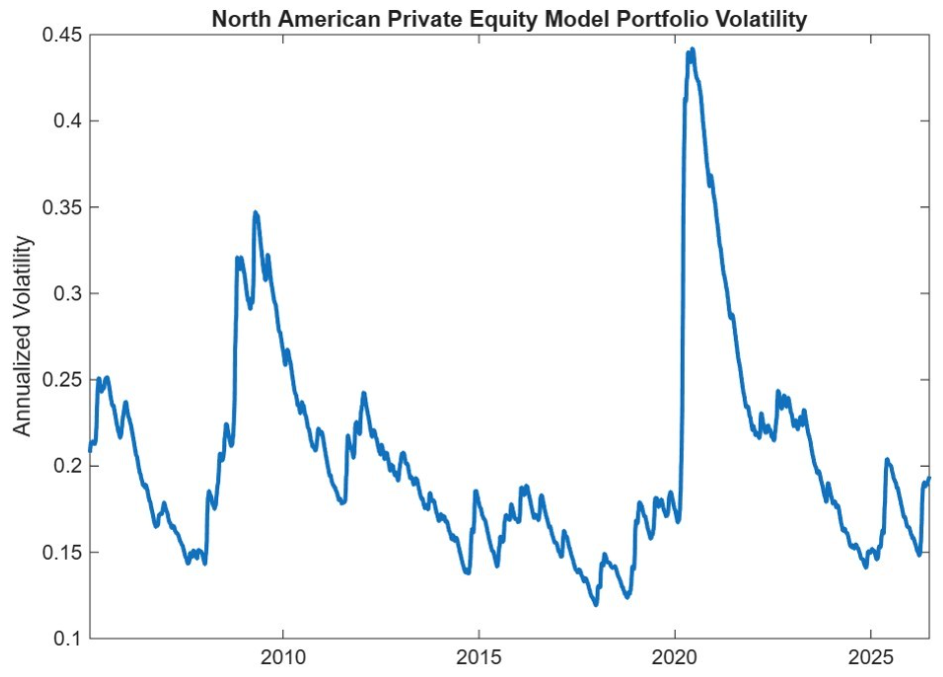
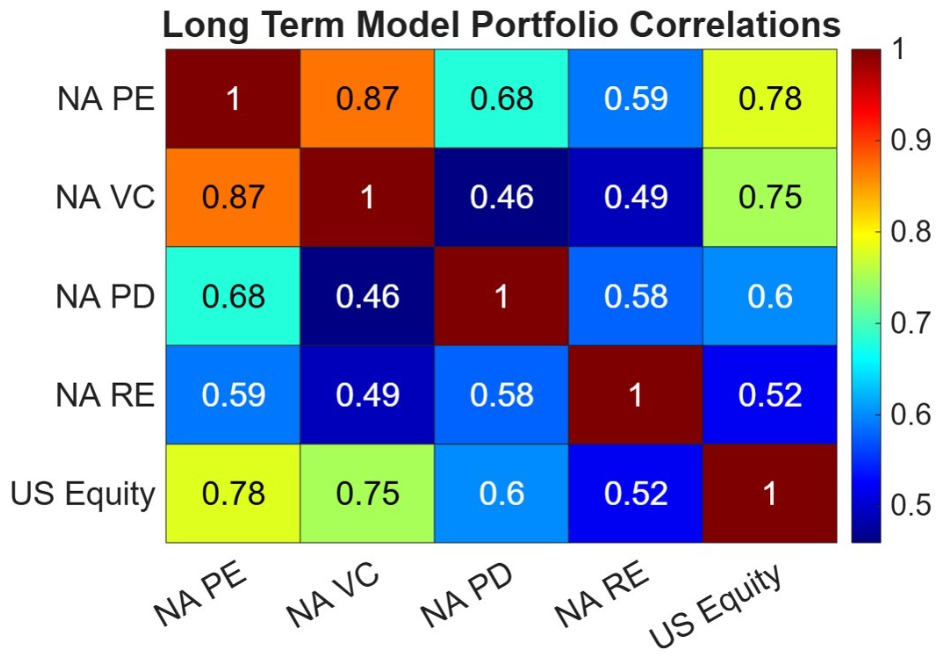
Cross-sectional regression of the desmoothed returns is used to estimate quarterly factor returns and establish betas to the public factors of the strategy indices, from which we can infer daily returns. This allows us to measure fund volatility and correlations, as illustrated in Figure 1 for the volatility of a North American Private Equity model portfolio, as well as in Figure 2 for correlations across fund types.
Figure 1: Time-varying volatility of a portfolio of North America Private Equity funds as derived from the Axioma Private Fund Factor Risk Model based on 20-day factor returns using the exponentially weighted moving average estimate with a six-month half-life and four-year look-back period
Source: Axioma Risk, Pitchbook Data, Inc.
From the volatility chart, it is clear that the risk of the modeled private fund portfolio returns tracks with overall economic events such as the global financial crisis and COVID, while the correlations with the US equity market returns are, as expected, higher than the correlations of typical fund distribution payments described above.
Figure 2: Heatmap of the long-term correlations between model portfolios for North America Private Equity, Venture Capital, Private Debt, Real Estate and US public equities, based on 20-day returns as generated by the Axioma Private Fund Factor Risk Models
Source: Axioma Risk, Pitchbook Data, Inc.
Applications of the factor model framework
There are several advantages to this factor framework which are particularly relevant to a Total Portfolio Approach to risk and allocation. The covariance structure of private factor returns with factors derived from public markets captures the total risk across a portfolio, while allowing views on market scenarios and associated economic performance to be integrated into private fund risk analysis. Stress testing portfolios to market shocks or against historical economic cycles (recession, growth, inflation, etc.) is possible, as is risk-based portfolio construction. While this does not have the same implications for portfolio rebalancing and hedging often used with liquid portfolios, understanding the breakdown of risk across the total portfolio can help inform allocation decisions by exposing risk concentrations. Key applications include:
- Total Portfolio Risk Attribution: The factor structure allows the portfolio risk of all assets to be decomposed into contributions across various dimensions, including asset classes, geographies and factors. Portfolio risk concentrations are readily identified and can be used to guide future investment decisions including potential rebalancing through selling into the secondaries market.
- Total Portfolio Asset Allocation: The risk exposures of a portfolio across factor models can be aggregated and translated into exposure to macroeconomic factors such as growth, rates, inflation, credit, etc. Long horizon views on risk and return of the macroeconomic factors can provide insight into the potential performance of the current portfolio while providing a portfolio construction framework for risk-based Total Portfolio Approach that incorporates these views.
- Cash Flow Modeling: A challenge for forecasting the timing and amounts of fund contributions and distributions is the incorporation of forward-looking economic scenarios. The conditional fund return distribution for fund categories implied by the factor model framework for macroeconomic scenarios can help adjust cash flow forecasting models, whether deterministic or stochastic, in capturing these views.
FAQs
FAQs
Q: Do private fund investors face real market risk if their funds rarely trade?
A: Yes. While private funds lack a liquid secondary market, fund performance is systematically linked to public market returns, meaning market risk is real even without frequent trading.
FAQs
Q: Is market risk for private funds just a red herring, with liquidity management being the real concern?
A: No. While cash flow and liquidity management are important, market risk is also relevant both for managing liquidity and for informing broader asset allocation decisions.
FAQs
Q: What is ∆DPI and why is it of interest?
A: ∆DPI is the change in Distributed to Paid-In capital over a given period. It's used because it depends only on observed cash flows during a specified interval without incorporating manager valuations, making it a simpler way to detect correlations with public market returns.
FAQs
Q: Why do private fund valuations need to be "desmoothed" before measuring risk?
A: Private fund valuations are often based on appraisals adjusted incrementally from the prior quarter, which creates artificially stable, autocorrelated returns. Desmoothing corrects this to reveal more realistic volatility and risk estimates.
Footnotes
[1] Ang, Andrew, Bingxu Chen, William N. Goetzmann, and Ludovic Phalippou, 2018, Estimating private equity returns from limited partner cash flows, Journal of Finance 73, 1751–1783.
[2] Kaplan, Steven N., and Antoinette Schoar, 2005, Private equity performance: Returns, persistence, and capital flows, Journal of Finance 60, 1791–1823.
[3] Korteweg, Arthur, and Stefan Nagel, 2016, Risk-adjusting the returns to venture capital, Journal of Finance 71, 1437–1470.
[4] Morokoff, W. and S. Islam, A more granular factor approach to private asset fund risk, Axioma Research white paper (2026). Contact us for access.
Related content