
EQUITY RISK MONITOR HIGHLIGHTS
WEEK ENDED SEPTEMBER 4, 2026
Axioma Risk Monitor: S&P 500 equal weight takes the lead as its relative risk touched the lowest point in 36 years; Health Care strengthens with little impact on US market risk; Emerging Markets are becoming a two-country chip trade
S&P 500 equal weight takes the lead as its relative risk touched the lowest point in 36 years
US equities were pulled in opposing directions last week by mixed developments in the Middle East and shifting interest rate expectations. Following Friday’s strong jobs report, market-implied odds of a rate hike increased and stocks sold off into the close, leaving the S&P 500 little changed for the week. The equal-weighted S&P 500 slipped modestly (70 basis points), as mega-cap stocks supported the index while the average stock declined.
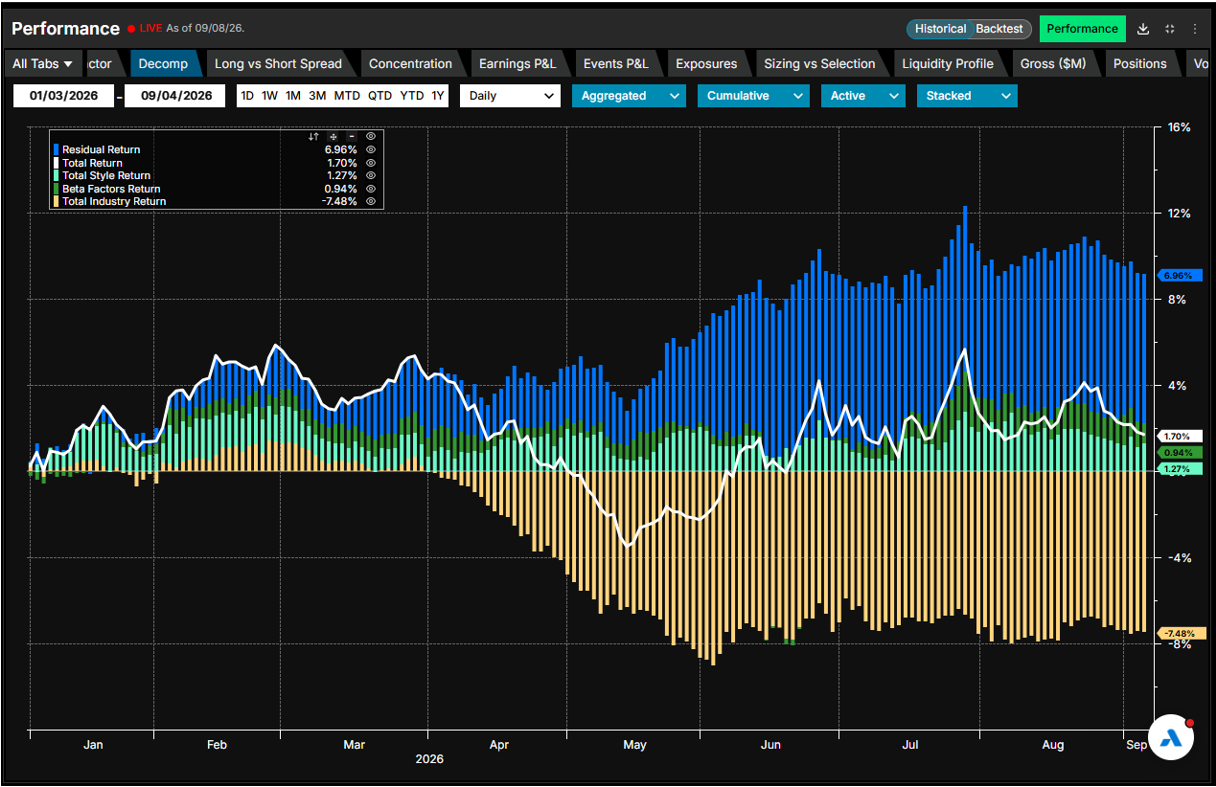
Despite last week's weakness, the equal-weighted S&P 500 has delivered stronger performance than the cap-weighted benchmark so far this year. It has returned 15% year to date versus 14% for the S&P 500 index. According to factor attribution based on the Axioma US51 Fundamental Short-Horizon Model, stock-specific returns contributed 7 percentage points of excess return and style exposures added another 3 percentage points, more than offsetting a 9-point drag from the portfolio’s underweight position in the technology industries that dominate the cap-weighted index.
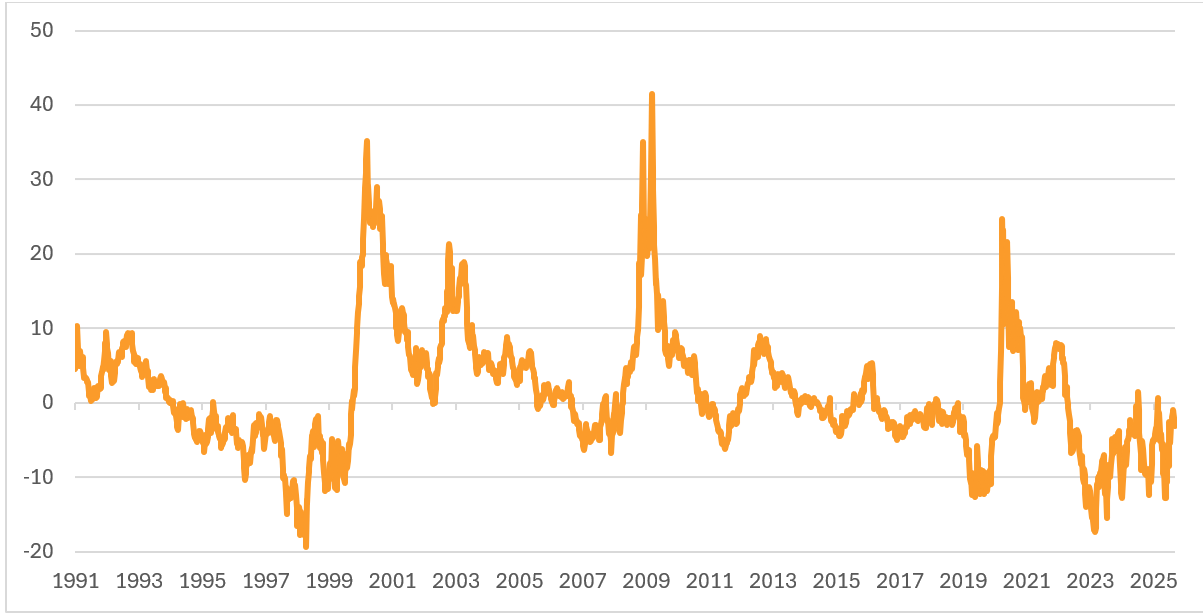
Even so, equal-weight's leadership remains a relatively recent development, as its trailing 12-month return still lags the cap-weighted benchmark. The last period in which the equal-weighted S&P 500 led on a one-year basis was between April 2022 and April 2023. Historically, the largest trailing-year advantage for equal weight occurred during periods of recoveries from severe market stress, including the COVID-19 pandemic, the Global Financial Crisis, and the dot-com collapse.
Meanwhile, risk concentration within the cap-weighted S&P 500 has intensified this year. The seven largest U.S. companies (eight stocks, given Alphabet’s dual share classes) now represent 35% of the index but account for more than half (54%) of its total risk, up from 50% at the end of 2025. NVIDIA alone contributes 17% of index risk, more than double its weight. The Semiconductors industry now represents 41% of total index risk, up sharply from 28% at the start of the year. By contrast, Energy's contribution to index risk has shifted from positive at the end of 2025 to negative today.
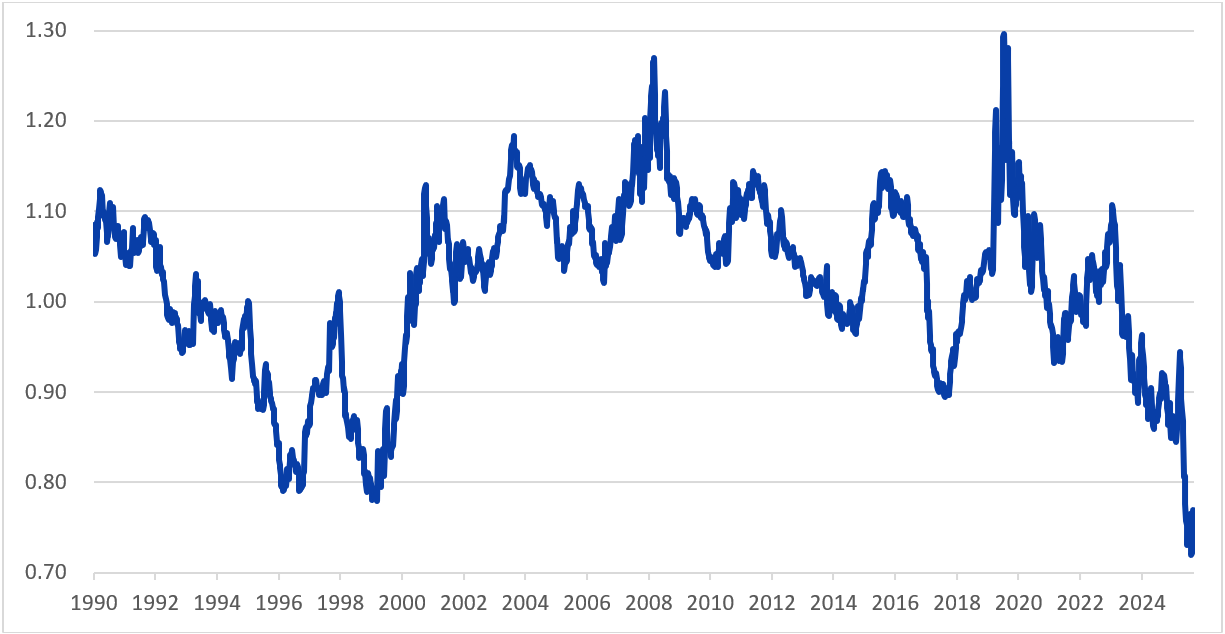
The risk implications of these weighting dynamics have reached levels not seen in the available historical record. The predicted risk of the equal-weighted S&P 500 has been lower than that of its cap-weighted counterpart since May 2024, with the gap reaching its widest level on August 7, marking the largest divergence in 36 years of weekly history dating back to 1990. For much of that period, the equal-weighted portfolio was the riskier option, at times carrying as much as 30% more risk than the cap-weighted index during mid-2020. Even previous episodes of concentration, including the technology-driven rally of the late 1990s, did not produce a divergence of today's magnitude. Put differently, owning the equal-weighted index has become the lower-risk alternative, largely because it maintains a significant underweight to the technology trade.
The equal-weighted index has paired outperformance with a meaningful risk advantage this year. Whether it can retain both as rates stay higher for longer remains to be seen.
The charts below is not included in the Equity Risk Monitors but is available upon request:
S&P 500 Equal-Weighted vs Cap-Weighted YTD Active Return Decomposition
Source: Arcana, Axioma
Spread between Equal Weighted and Cap Weighted S&P 500 12-month trailing return
Source: S&P, Axioma
Ratio of S&P 500 Equal-Weighted vs Cap-Weighted Short-Horizon Risk
Source: S&P, Axioma
Health Care strengthens with little impact on US market risk
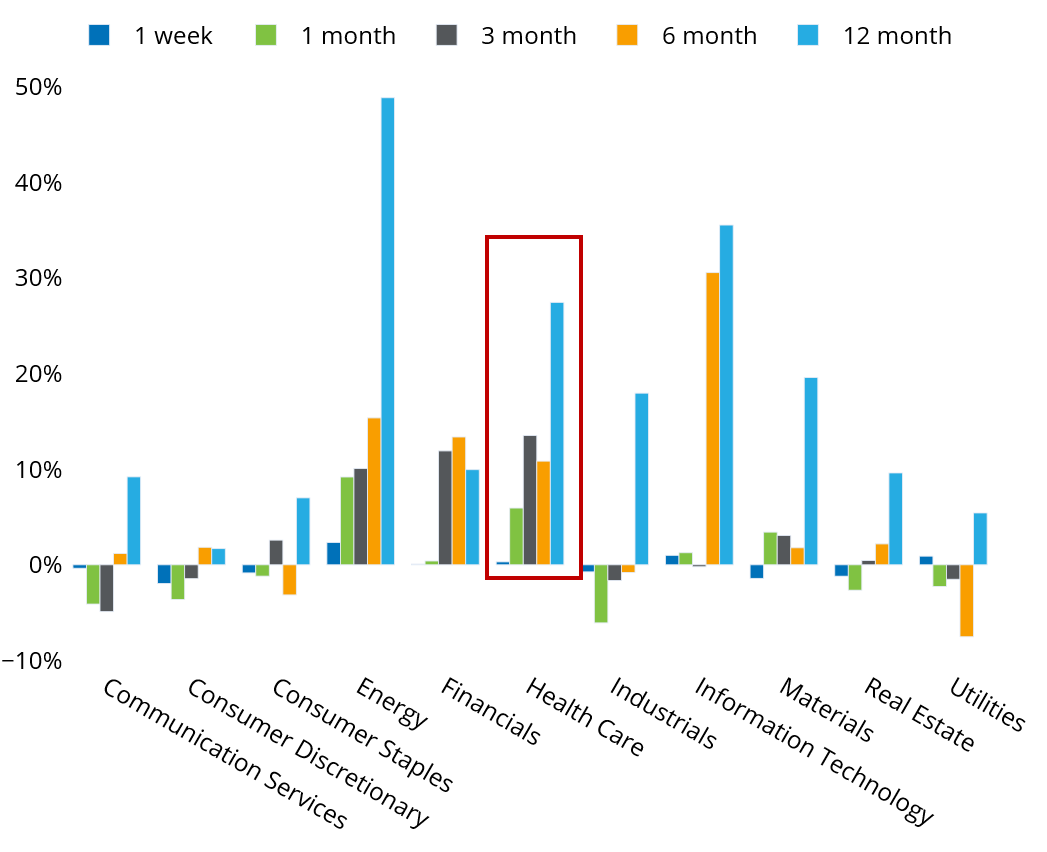
News of breakthroughs in personalized cancer therapies boosted Health Care stocks recently, but the sector's rally was already well underway. Health Care gained nearly 6% over the past four weeks, making it one of the largest positive contributors to the Russell 1000’s monthly return. However, Health Care is now the third best-performing sector in the index, after Energy and Info Tech, over the past year.
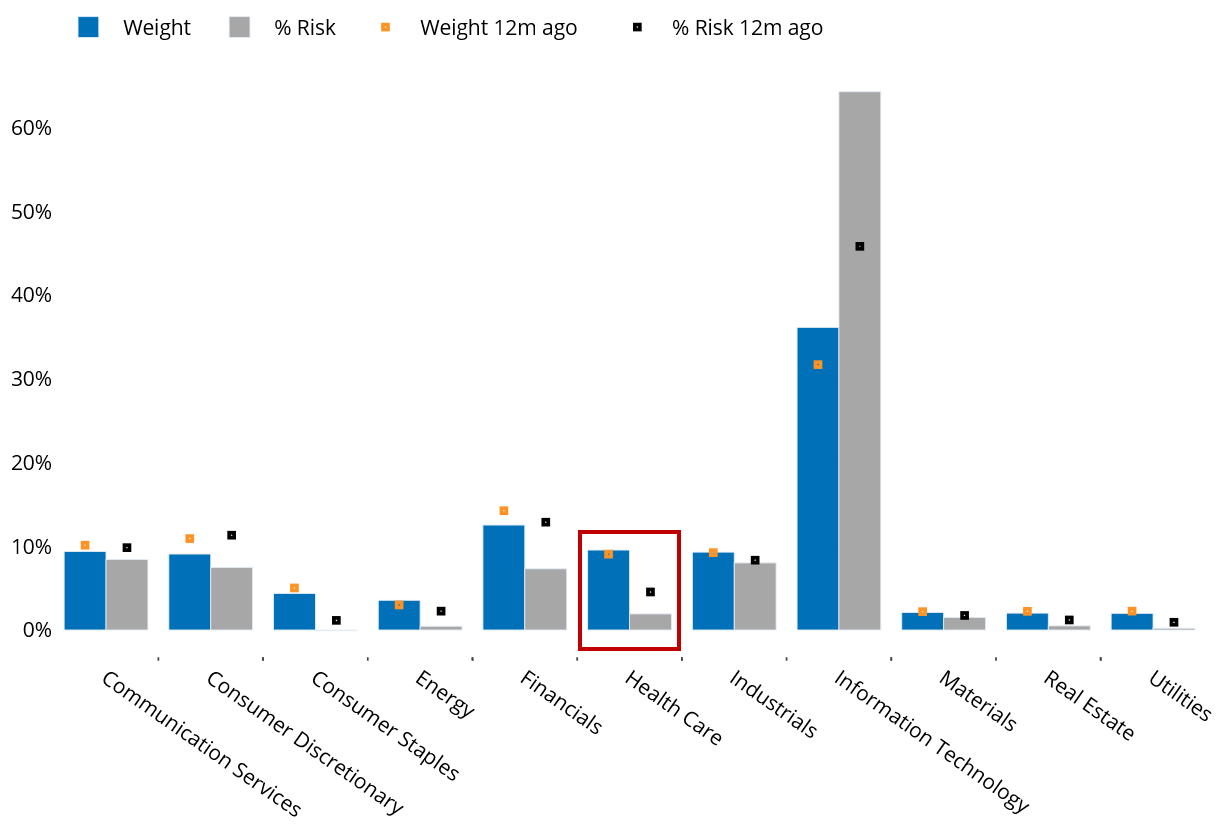
Despite representing nearly 10% of the Russell 1000, Health Care accounts for just 2% of benchmark risk, according to the Axioma US51 Fundamental Medium-Horizon Model. While its index weight has remained largely unchanged, its contribution to benchmark risk has fallen from 4.5% a year ago. Although the sector's own volatility has increased during that period, its relatively low correlation with the technology sector, the US market's dominant driver, has kept its impact on overall benchmark risk muted.
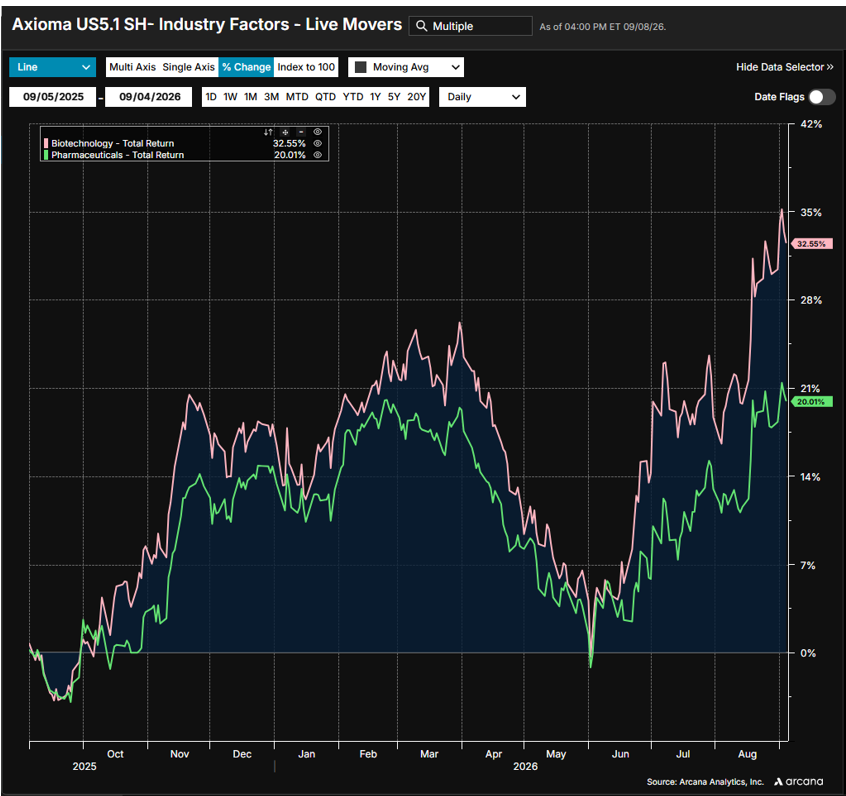
Notably, Axioma's Health Care industry factors turned positive well before the recent headlines. These factor returns measure industry performance after removing the effects of broader market movements and style exposures. Pharmaceuticals and Biotechnology factor returns have been climbing steadily since June, ahead of the current news cycle, with trailing 12-month returns now at +20% and +33%, respectively. Those figures rank in the 90th and 89th percentiles of their historical distributions since 2009 in the US51 Fundamental Short-Horizon Model.
The Semiconductors industry factor, up 63% over the same 12 months, has lost 9% since the start of June. At the factor level, Semiconductors is strongly negatively correlated with Pharmaceuticals (-0.45) and Biotechnology (-0.41), making them among the most negatively correlated industry pairs in the short-horizon US51 model. Net of market effects, the data suggest that capital has been rotating from semiconductors into Health Care for several months.
Health Care's contribution to benchmark risk remains modest for now, largely because of its low correlation with Technology. Whether that relationship holds will be worth watching, especially as AI adoption expands across industries, including Health Care.
See charts from the Russell 1000 Equity Risk Monitor as of 4 September 2026:
Russell 1000® - Sector Weights and % of Risk
Russell 1000® - Period Sector Return
The chart below is not included in the Equity Risk Monitors but is available upon request:
US51 – Biotechnology and Pharmaceuticals Industry Factor 1-Year Returns
Source: Arcana, Axioma
Emerging Markets are becoming a two-country chip trade
One of the biggest equity moves last week came from Korea. The KOSPI closed the week at a record high, bringing its advance over the past year to roughly 120%. Samsung Electronics and SK Hynix led the rally on expectations that the next generation of AI models will place additional strain on global memory-chip supply. The gains came as the US confirmed tariffs of up to 100% on chips not manufactured domestically.
The STOXX Emerging Markets Index gained 4.6% over the past month, and the usual drivers accounted for more than all of that return. Taiwan contributed 2.5 percentage points and Korea another 2.2 points, together exceeding the index's entire gain, while the remaining markets were a modest drag in aggregate.
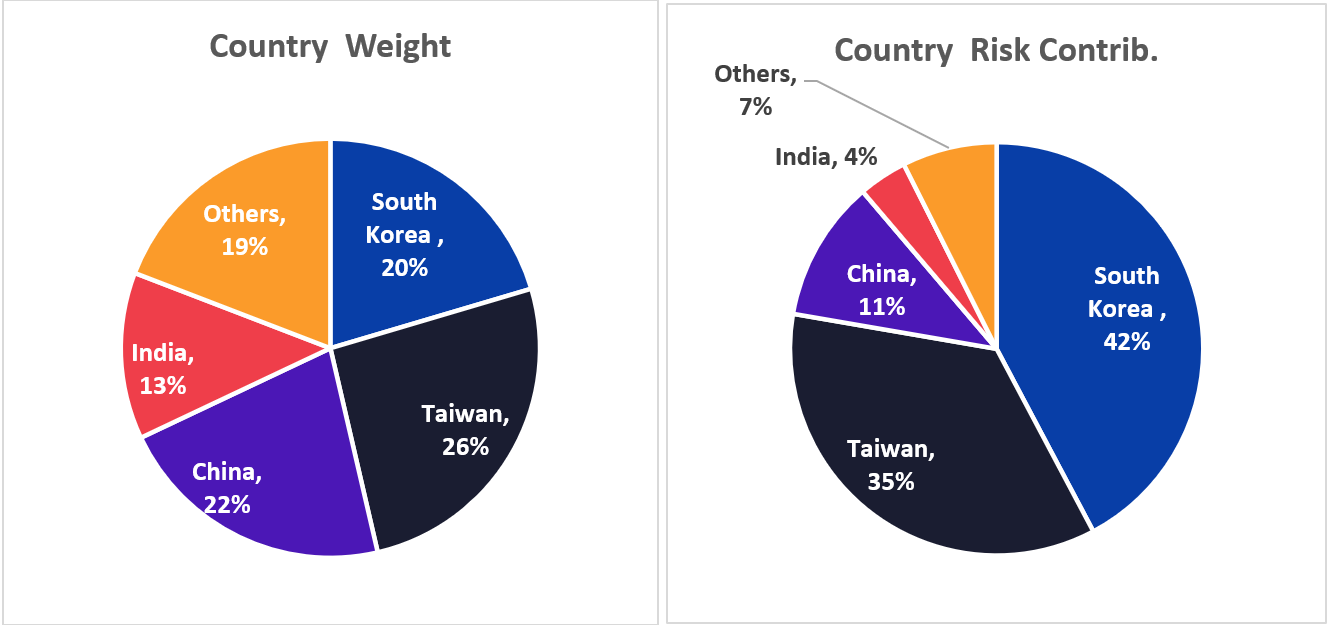
The rally has only reinforced the concentration already present in Emerging Markets. According to the Axioma EM4 Fundamental Short-Horizon Model, Korea and Taiwan account for 46% of the index's weight but contribute 78% of its risk. The effective number of stocks in the benchmark is just 37 despite having more than 2,400 constituents, compared with 54 for the Russell 1000.
For asset allocators, an emerging markets index fund currently offers less diversification than its name might suggest. In practice, it behaves increasingly like a concentrated semiconductor trade with significant exposure to just two markets.
In a week marked by record chip-driven gains in Korea and the introduction of a new US chip-tariff regime, the distinction between what the benchmark is called and what it actually delivers has become difficult to ignore.
The chart below is not included in the Equity Risk Monitors but is available upon request:
STOXX Emerging Markets
You may also like


