

MULTI-ASSET CLASS MONITOR HIGHLIGHTS
WEEK ENDED SEPTEMBER 11, 2026
Surging oil prices and ongoing fiscal concerns keep pushing global yields higher
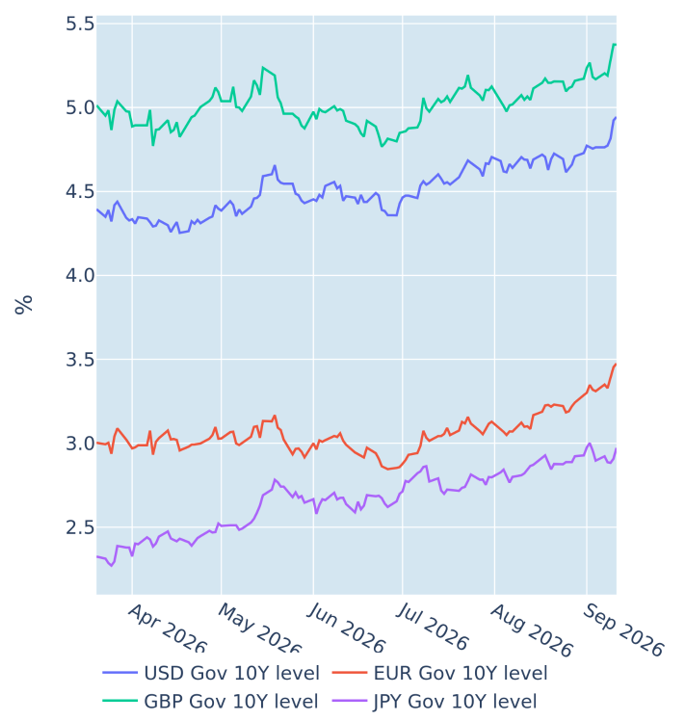
Global government bond yields extended their rise in the week ending September 11, 2026, as a renewed surge in oil prices and ongoing fiscal concerns pushed borrowing costs to fresh multi-year highs across major markets. The 10-year US Treasury yield soared 18 basis points to its highest level since October 2023 just under 5%, following a hotter-than-expected August producer price report and a weaker-than-expected Treasury buyback operation Thursday. The same-maturity German Bund benchmark rose by a similar amount to a 17-year high, after the European Central Bank raised its policy rates for a second time, while upping its average inflation projection for next year from 2.3% to 2.5%.
Notably, the rise in long-term financing rates was not accompanied by a corresponding increase in inflation expectations, despite oil prices resurging above $100 per barrel toward the end of the week. The 10-year US breakeven inflation rate rose by only 1 basis point over the week, after briefly touching a 5-basis-point gain in the wake of Thursday’s PPI report, but this still constituted only a small fraction of the 18-basis-point increase in the nominal yield. This indicates that the move reflected mounting fiscal concerns over debt issuance, rather than a resurgence in inflation risk.
However, the picture was once again very different at the short end of the curve, where fed funds futures traders raised the implied probability of a rate hike at the upcoming FOMC meeting from around 60% early in the week to 87% by the end of it. At the same time, the projected federal funds rate for June 2027 rose from 4.25% on Wednesday to 4.5% on Friday, despite US headline consumer price growth holding steady at 3.4%, in line with market expectations, while core inflation eased for a third consecutive month to 2.4%. As a result, the monetary policy sensitive 2-year yield ended the week 26 basis points higher, narrowing the 10y/2y term spread to 33 basis points — its tightest level since the start of July.
The flattening was even more pronounced in the UK market, where short yields rose 31 basis points by Thursday, as the 15-month SONIA forward rate jumped 46 basis points to 4.95%, implying around 120 basis points of tightening by the end of next year. This compared to a 22-basis point increase at the 10-year tenor.
Please refer to Figures 3 & 4 of the current Multi-Asset Class Risk Monitor (dated September 11, 2026) for further details.
Dollar again fails to benefit from higher US rates
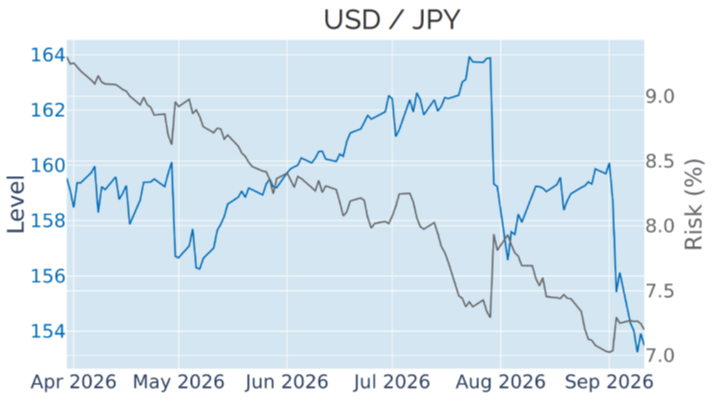
The sharp rise in interest rates once again did little to support the dollar, which ended the week largely unchanged against a basket of major trading partners. The muted reaction reinforces the notion of a broader loss of confidence in American assets, rather than a purely rate-driven dynamic, as the currency's traditional positive relationship with US yields continues to show signs of breaking down.
That said, this was not a case of broad-based dollar weakness either. The euro and the pound were both little changed against the greenback over the week, leaving the Japanese yen as the most notable mover. The currency gained around 1.7% to its strongest level in nearly seven months, with about two thirds of that move occurring on Monday, apparently in the absence of an obvious catalyst. Speculation around a more hawkish Bank of Japan may have played a role, but the historically weak — and at times inverse — relationship between Japanese interest rates and the yen suggests this explanation warrants some skepticism, unless the dollar's reduced sensitivity to US rates has extended to the yen's relationship with domestic policy as well.
Please refer to Figure 6 of the current Multi-Asset Class Risk Monitor (dated September 11, 2026) for further details.
Portfolio risk rises marginally as soaring oil price offsets stronger equity-rate correlation
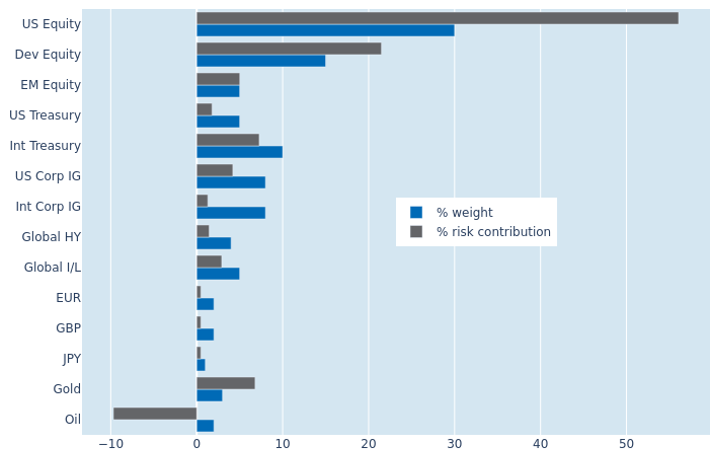
Predicted short-term risk for the Axioma global multi-asset class model portfolio rose only marginally, from 6.1% to 6.2% as of Friday, September 11, 2026, despite greater equity and bond market volatility and a stronger correlation between the two. The adverse effect of their combined selloff was largely offset by soaring oil prices and the accompanying inverse interaction with most other assets in the portfolio. US equities recorded the largest increase in risk contribution, rising 4.4 percentage points to 56.1%, driven by both higher standalone volatility and a stronger correlation with interest rate returns. Fixed income instruments as a group also added markedly more to overall risk, with their combined contribution rising from 13% to 18.9%. Oil, however, more than offset these increases, with its risk-reducing effect deepening from -5.6% to -9.7% as its correlation with both equities and interest rates turned more negative.
Please refer to Figures 7-10 of the current Multi-Asset Class Risk Monitor (dated September 11, 2026) for further details.
You may also like


