

Bad apples or a bad barrel?
Author:

AI remains an infrastructure-financing story before it becomes a software story. Using Axioma Credit Spread Curves in Snowflake, we built an AI funding chain to create a credit-market early-warning system for the build-out. The evidence continues to point to a handful of highly exposed borrowers rather than a broader repricing of the AI ecosystem, though signs of investor concern are beginning to appear among some suppliers.
Building a credit-market early-warning system for the AI build-out
Investors are not questioning AI. They are questioning who gets financed, at what cost, and for how long.
Last week markets experienced another bout of AI-related volatility, this time focused on leverage within the AI build-out itself. The question was not whether investors had become less enthusiastic about artificial intelligence. It was whether investors were beginning to demand a higher risk premium from a handful of heavily indebted borrowers, or from the AI build-out as a whole.
The valuations attached to AI ultimately assume widespread adoption, productivity gains and future revenues, but revenues come after infrastructure. Data centers need permits, servers need chips, chips need power and power needs transmission capacity, all of which require enormous amounts of capital. At this stage, AI is best understood less as a software story than as an infrastructure-financing story.
Infrastructure booms promoted as future revenue engines are often celebrated by equity investors and tested by credit investors. Equity investors participate in the upside if the build-out succeeds; credit investors do not. Their return is largely limited to the coupon they expect to earn and the return of principal, making them more sensitive to changes in perceived repayment risk. If investors begin questioning whether future AI revenues will justify the debt being raised today, those concerns should appear in credit spreads before they appear in earnings.
Using the breadth of the Axioma Credit Spread Curves universe in Snowflake, we assembled an AI funding chain spanning the companies creating the demand for capital, those supplying and enabling the infrastructure, the lenders financing it and, ultimately, the broader credit market. This is not a supply chain in the traditional technology sense. It is a funding chain, designed to follow capital rather than products.
Money flows first to the hyperscalers creating the demand for infrastructure, then to the builders constructing it, then to the suppliers providing chips and equipment, followed by the power, real-estate and connectivity companies enabling it. Behind them stand the lenders and insurers providing much of the financing, while the broader credit market sits at the end of the chain. If financing conditions deteriorate, investors should demand additional compensation in roughly that order.
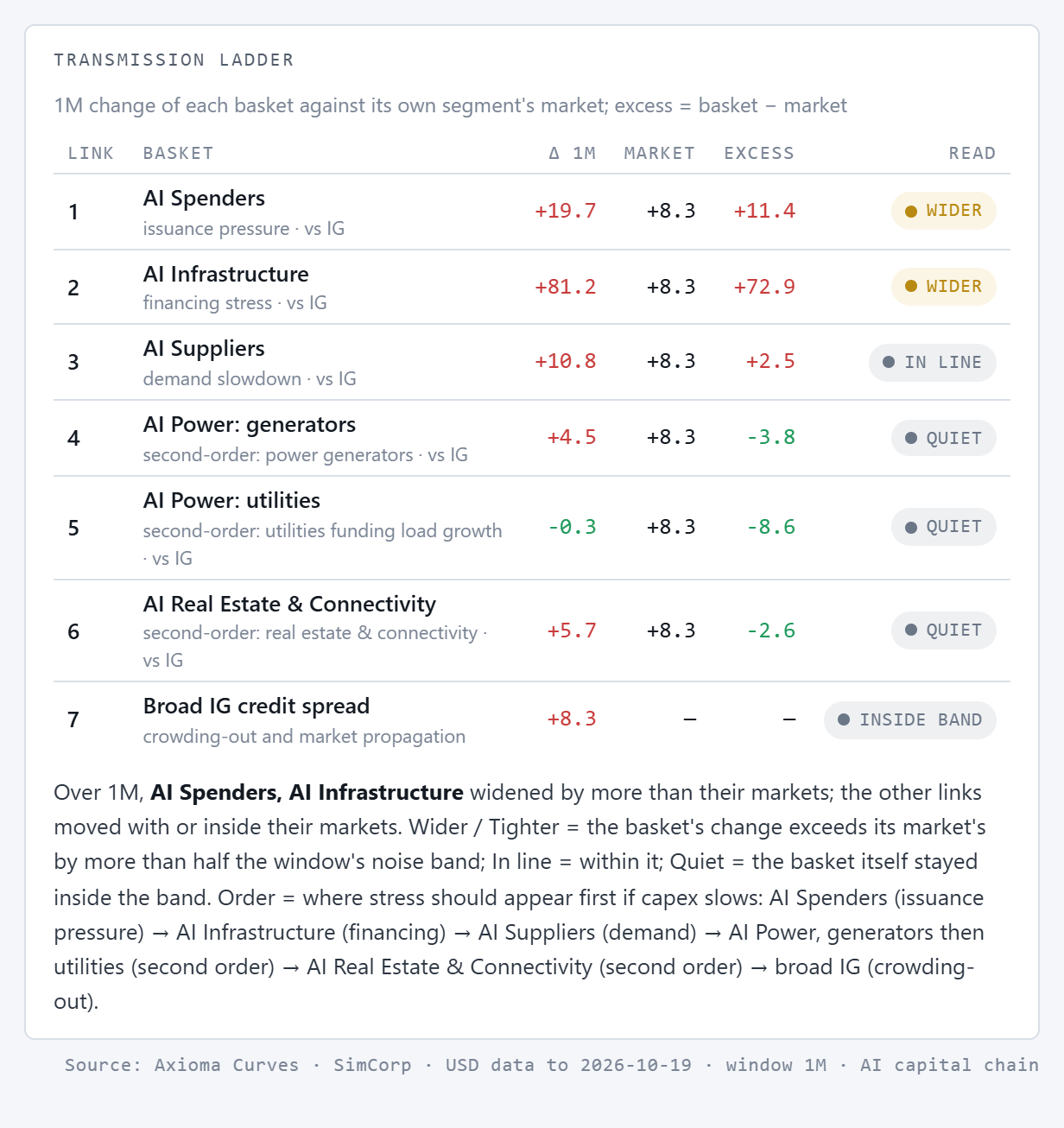
Three names on that list stand out. Over the past month, spreads widened by 189 bp for CoreWeave, 119 bp for SoftBank and 84 bp for Oracle. Each occupies a strategically important point in the chain. CoreWeave operates AI cloud infrastructure. Oracle is one of the largest spenders on data-Centre capacity. SoftBank has borrowed heavily while increasing its exposure to the ecosystem through OpenAI.
Last week, those three became investors' preferred vehicles for expressing doubts about parts of the AI build-out. The more important question is whether those doubts end with three highly exposed borrowers or spread elsewhere in the chain and eventually into the broader credit market.
To answer that question, we removed the three obvious weak links from the chain and asked it again. If investors were reassessing the economics of the AI build-out itself rather than a handful of heavily exposed borrowers, signs of concern should still be visible elsewhere.
The answer was no. Remove CoreWeave, Oracle and SoftBank from the chain and most of the apparent stress disappears with them. The remaining borrowers performed broadly in line with, and in some cases better than, comparable issuers with similar credit profiles. Whatever investors were worried about last week, the evidence suggests it was concentrated in a handful of borrowers rather than the chain itself.
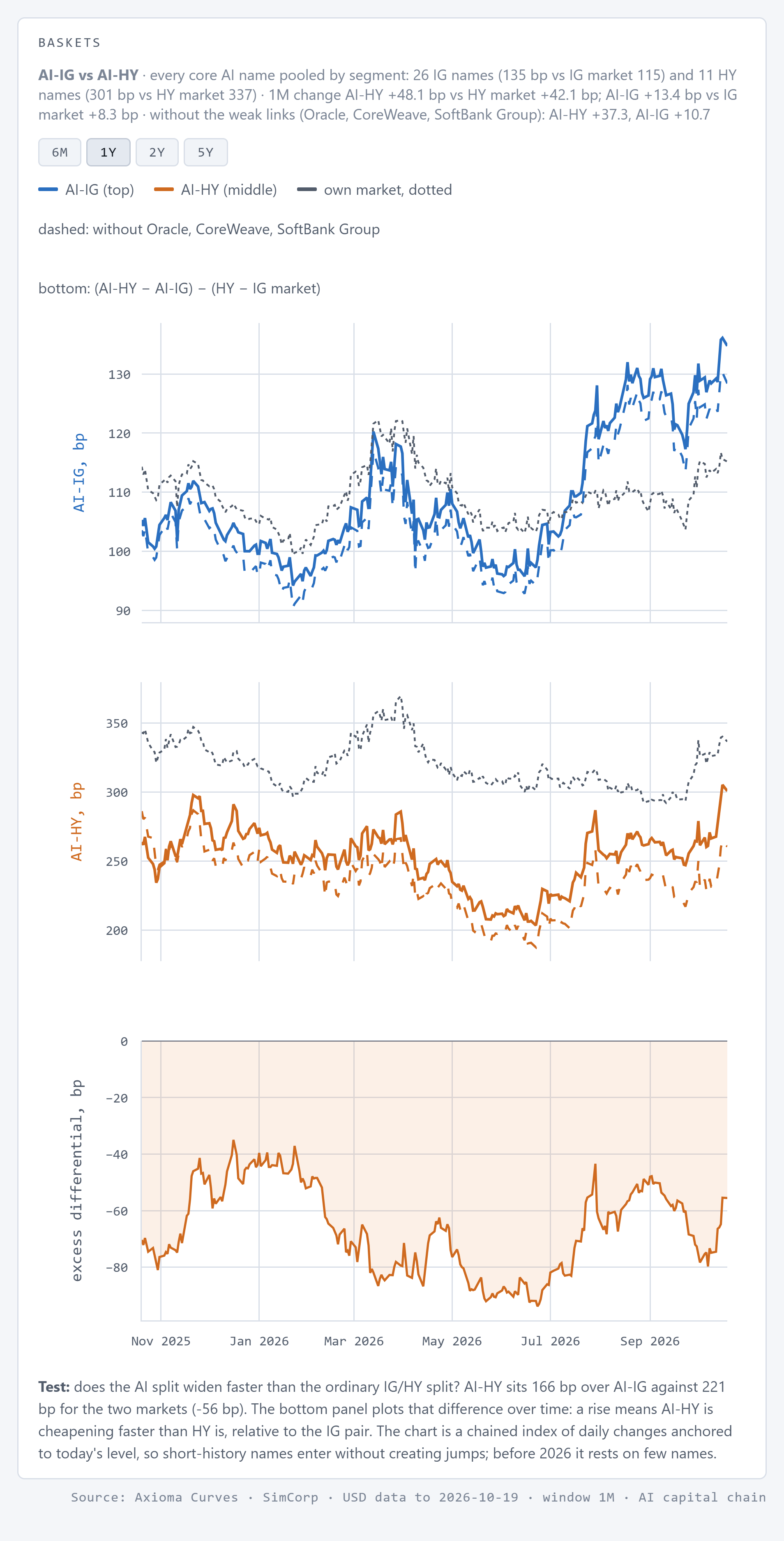
That does not mean investors have no concerns about the rest of the chain. What stands out about CoreWeave, Oracle and SoftBank is not where they sit in the chain but the balance sheets behind them. Microsoft, Amazon and Alphabet remain among the strongest credits in the ecosystem and still borrow more cheaply than most of the investment-grade market, although investors now demand more compensation than they did a year ago. Meta sits somewhere between the two extremes. CoreWeave, Oracle and SoftBank sit at the other end, where spread widening has been materially larger.
Investors are still differentiating sharply between strong and weak balance sheets. The strongest names remain the cheapest borrowers in the chain. The difference is that investors are now asking for a little more compensation from almost everyone involved in funding the build-out, and a great deal more from the borrowers with the least room for error.
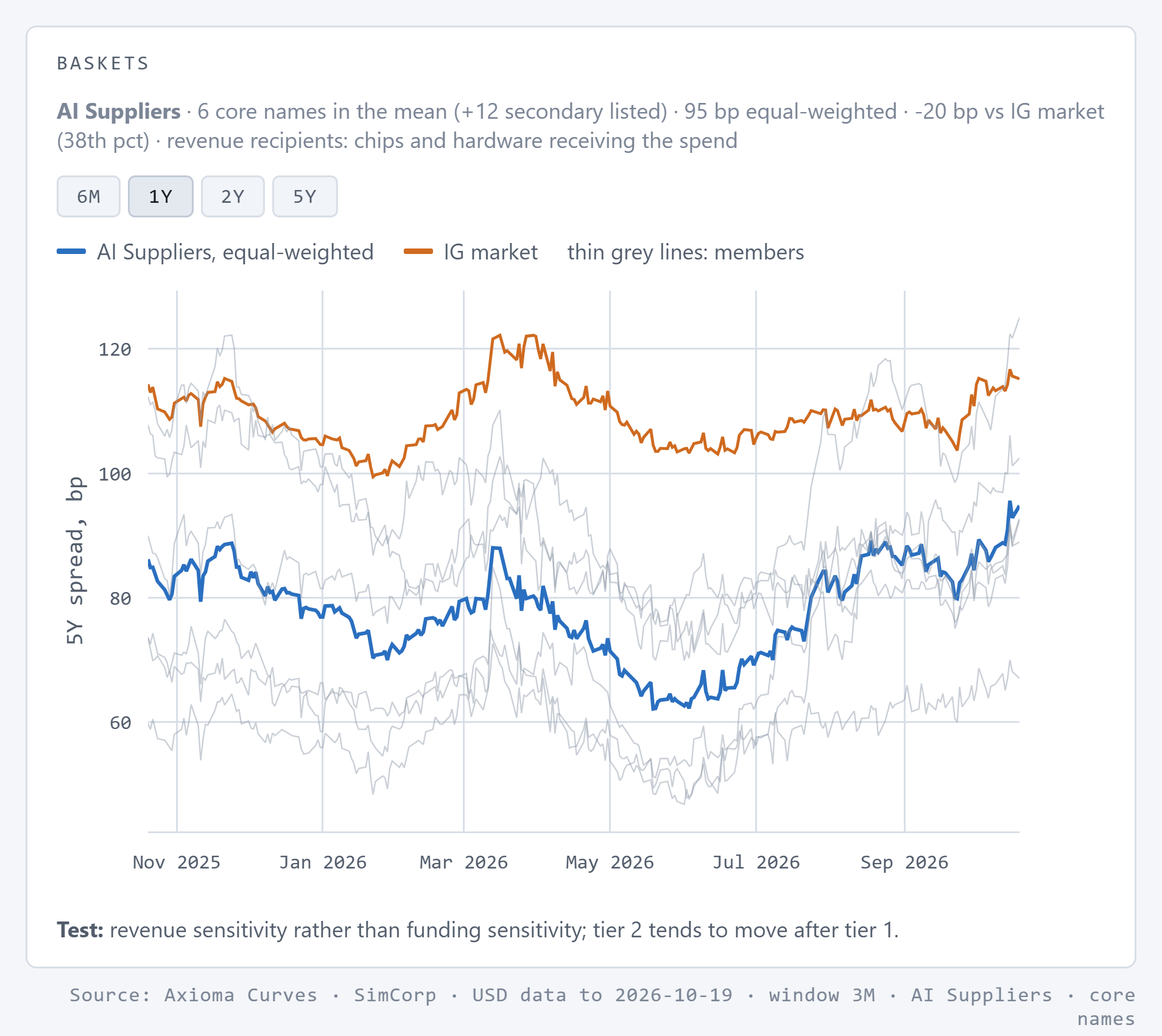
The more interesting development lies one step further along the chain among the suppliers. Over the past three months, Nvidia widened by 20 bp and Broadcom by 34 bp while the broader investment-grade market moved by roughly 6 bp.
Neither company faces the same financing pressures as CoreWeave, Oracle or SoftBank. Yet both have become increasingly entangled in the economics of the build-out. Nvidia has guaranteed rent on an OpenAI data-Centre project, while Broadcom has backed a vehicle designed to lease chips to Anthropic. As the ecosystem has expanded, both companies have moved beyond selling products and become participants in the financing architecture supporting their customers.
Some market commentators have described Nvidia as the 'central bank' of the AI ecosystem because of the role it increasingly plays as a financial backstop. Whether that description proves fair is less important than what the spread data may be signaling. If investors are demanding a higher risk premium to lend to one of the most profitable companies in the chain, it raises obvious questions about how they may eventually view the smaller and less profitable borrowers further down it.
Monday's data did little to change the bigger picture. CoreWeave retraced part of its widening, Oracle widened again and SoftBank remained elevated. Investors appear to be demanding more compensation from a handful of highly exposed borrowers rather than from the AI funding chain as a whole.
Remove those names from the analysis and most of the apparent stress disappears with them. The remaining builders, suppliers, enablers and financiers continue to trade broadly in line with their respective markets, suggesting that investor concerns remain concentrated rather than systemic.
Credit crises rarely begin with an entire theme being repriced at once. They often begin with a small number of borrowers that investors decide deserve closer scrutiny. CoreWeave increasingly occupies that role within the AI build-out, not because it represents the entire chain but because it sits at the intersection of the chain's most aggressive assumptions.
For now, the evidence still points to a handful of weak links rather than a stressed system. The suppliers now bear watching. Bad apples spoil a barrel by contact. The question is whether that contact remains confined to a few borrowers or begins moving through the chain itself.
Related content


