Sector bets aside, what’s really driving credit portfolio risk?
Author:

This analysis compares a traditional sector-based view of credit portfolio risk with a factor-based approach using the Axioma Global Fixed Income Model (AXGFIM) on Snowflake. Applied to a high yield bond ETF, we found that two apparent sector bets accounting for most of the fund’s tracking error can mask very different risk sources. This reveals whether a portfolio manager’s sector positioning reflects a broad market view or issuer-specific calls.
The traditional approach: Portfolio risk by sector
Credit portfolios are typically managed and assessed along sector lines. Benchmark indices are sliced by industry classifications, and traditional credit risk models often compute a sector's contribution to tracking error using average spread levels. But this convention can obscure other, more significant underlying return drivers.
The Axioma Credit Spread Factor Model (CSFM), the component within the AXGFIM that models credit risk, takes a different approach to decomposing that risk. It borrows the cross-sectional regression techniques used in equity factor models and applies them to issuer credit spread curves, which are also available on Snowflake. The model produces a set of statistically estimated market, quality, region, and industry factors, with any unexplained, residual risk captured in a specific-risk term.
The following worked example shows how the Axioma CSFM can help credit portfolio managers to identify underlying sources of risk that may not be obvious when using a traditional, sector-based approach.
The traditional approach: Portfolio risk by sector
The portfolio we use in this analysis is an active, USD-denominated high yield bond ETF benchmarked against the ICE BofA US High Yield Constrained Index (HUC0). Figure 1 shows some key attributes and risk measures for the portfolio and its benchmark, broken down by GICS sector. At the aggregate level, the portfolio is slightly short duration (-0.29 years) and carries a lower average spread (236 basis points versus 264 basis points), resulting in an overall Duration Times Spread (DTS) underweight of -1.53. The predicted tracking error is 44 basis points.
Figure 1. Key portfolio and benchmark attributes by sector
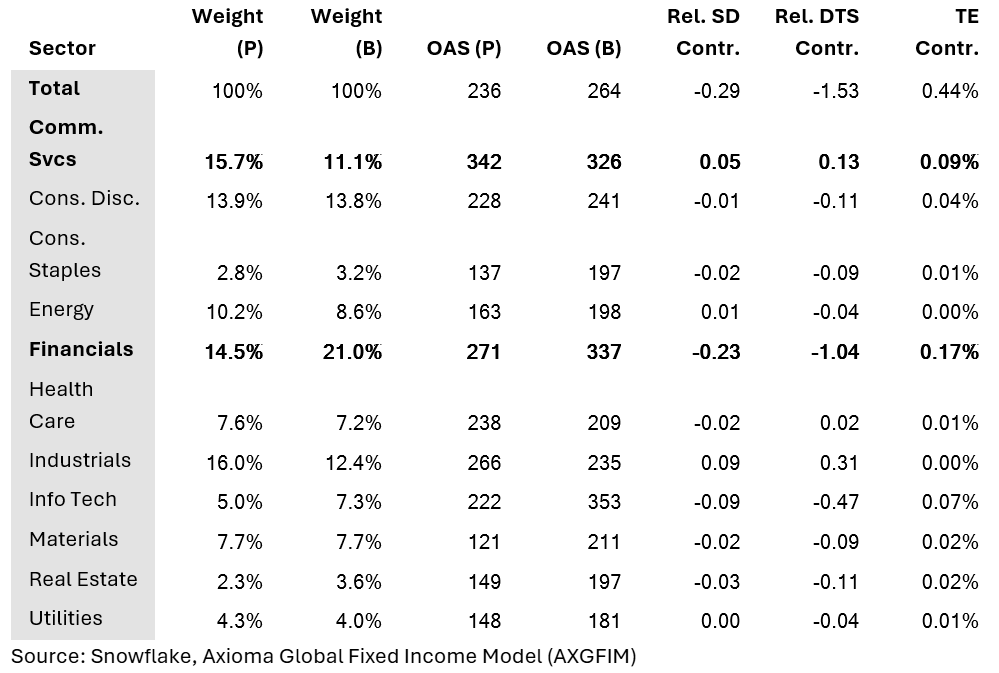
A conventional sector-based decomposition attributes the largest share of that tracking error to two sectors. Financials is the portfolio's largest underweight, both in terms of spread duration and the markedly lower average spread of the bonds held, contributing 17 basis points. Communication services is close to neutral relative to the benchmark when comparing spread duration contributions, so the fact that it adds a further 9 basis points to active risk points toward an alternative source of risk within the sector, most likely a divergence in securities held.
The factor-based approach: Axioma CSFM
Applying the CSFM to the same portfolio provides an alternative breakdown of the 44 basis points of tracking error, shown in Figure 2. Roughly 18 basis points derive from the portfolio's exposure to the overall direction of credit spreads, while interest rates, quality, region, and industry show no meaningful contributions at all. The larger component of 25 basis points is specific risk, reflecting issuer-level positions that no systematic factor explains.
Figure 2. Total tracking error breakdown by risk factor
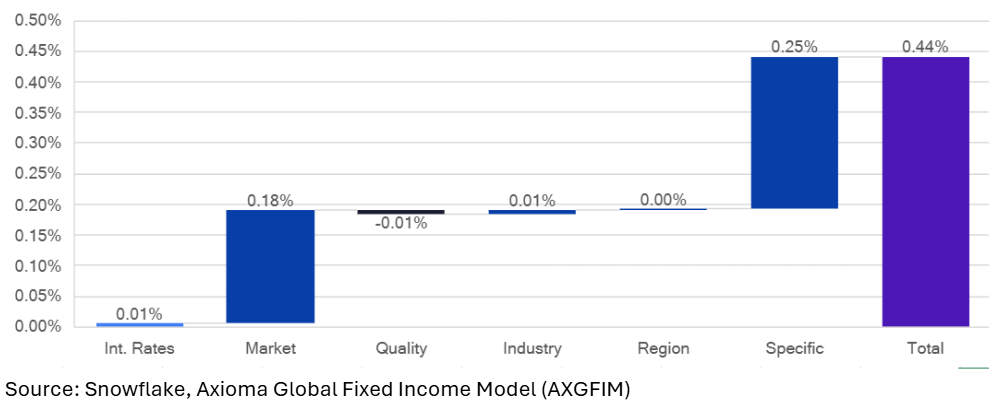
The industry factors' negligible contribution may seem counterintuitive, given the sizable sector over- and underweights identified above. But using the CSFM to break down each sector's own tracking-error contribution sheds a different light on where the risk is actually coming from.
Bringing the two views together
Financials and communication services together account for almost 60% of the portfolio’s active risk. But their underlying risk profiles show very different sources for those contributions.
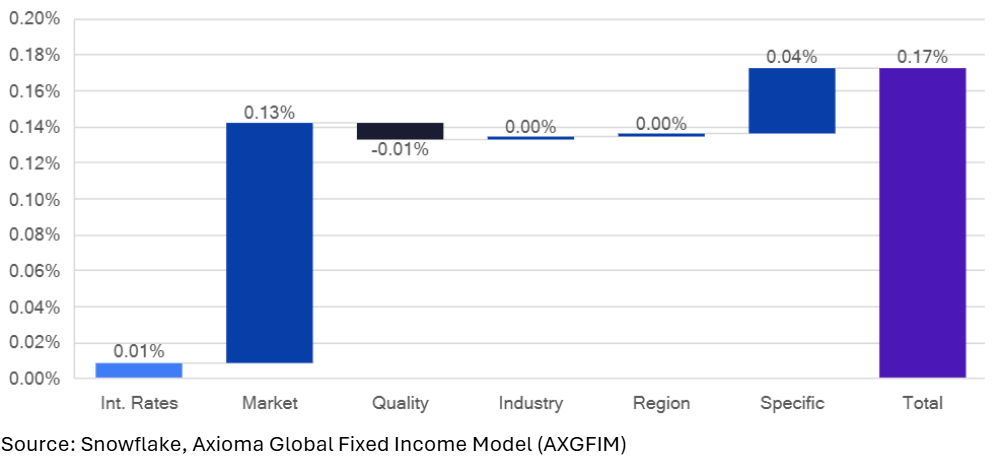
Figure 3 reveals that roughly three quarters of financials' TE contribution of 17 basis points derive from the market factor (i.e., exposure to the overall direction of credit spreads), which is a direct consequence of the sector's large negative DTS exposure. But despite the size of the DTS underweight, the industry and region factors contribute very little, with the remaining 4 basis points coming from specific risk instead. The fact that the average spread of the financial bonds held by the portfolio is significantly lower than that of their counterparts in the benchmark indicates a considerable mismatch of names between the two.
Figure 3. Detailed risk breakdown for financials sector
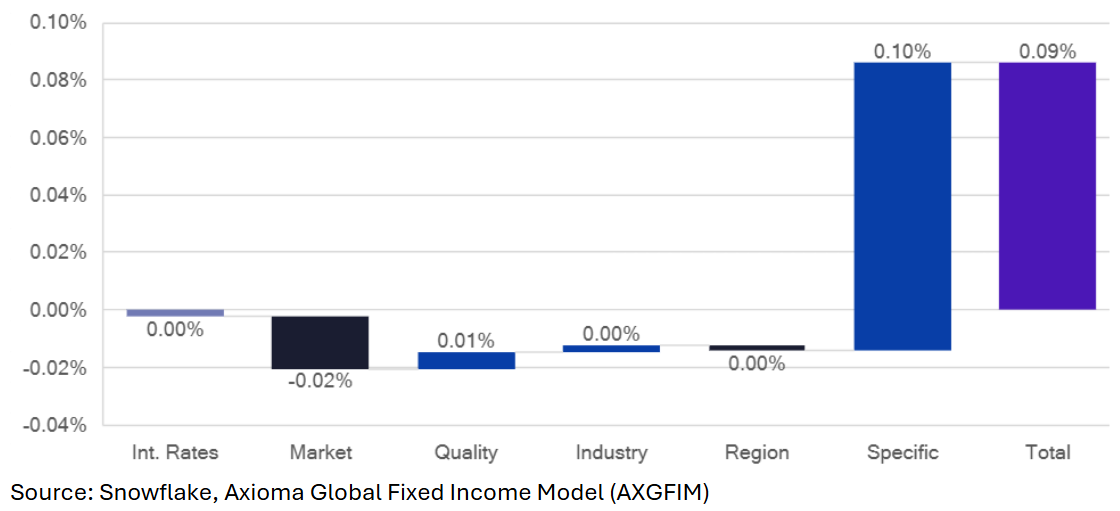
The picture for communication services is almost the opposite. A shorter duration in the portfolio combined with the sizable monetary overweight keeps the sector's net contribution to interest rate risk close to zero. At the same time, the higher average spread of the bonds held narrows rather than widens the DTS mismatch, producing a small negative, risk-reducing contribution of roughly -2 basis points from the market factor. With the sector's overall risk weight close to the benchmark's, the remainder of the 9-basis point contribution is attributable almost entirely to specific risk rather than a view on the sector itself.
Figure 4. Detailed risk breakdown for communication services sector
The importance of having an alternative lens
From the strong underweight in financials, we can assume that the portfolio manager holds a negative view on that sector as a whole, while the Option Adjusted Spread (OAS) differential seems to point toward some name-specific bets as well. The fund's spread-duration contribution for the communication services sector, on the other hand, is close to that of the benchmark, while most of the active risk appears to come from the difference in spread, indicating that the PM is neutral on the sector overall, but seems to have strong views on some of the underlying names.
The Axioma CSFM supports this reading for communication services, where almost the entire TE contribution turns out to be specific risk, with no meaningful role for the industry factor. For financials, however, the model shows that the underweight carries almost no industry-related risk either, so it appears to be less a bet on the sector and more a bet on the general direction of credit spreads.
Having an alternative, factor-based view on credit risk can provide valuable information for portfolio managers, either confirming that the risks taken are as intended, or revealing underlying exposures that can then be mitigated if required.
To learn more about the Axioma CSFM, get in touch with our team.
FAQs
Related content