

EQUITY RISK MONITOR HIGHLIGHTS
WEEK ENDED JULY 10, 2026
- US up, other markets down, on mixed sector returns
- Drilling down into Emerging Markets risk
- US factor performance may be causing whiplash
US up, other markets down, on mixed sector returns
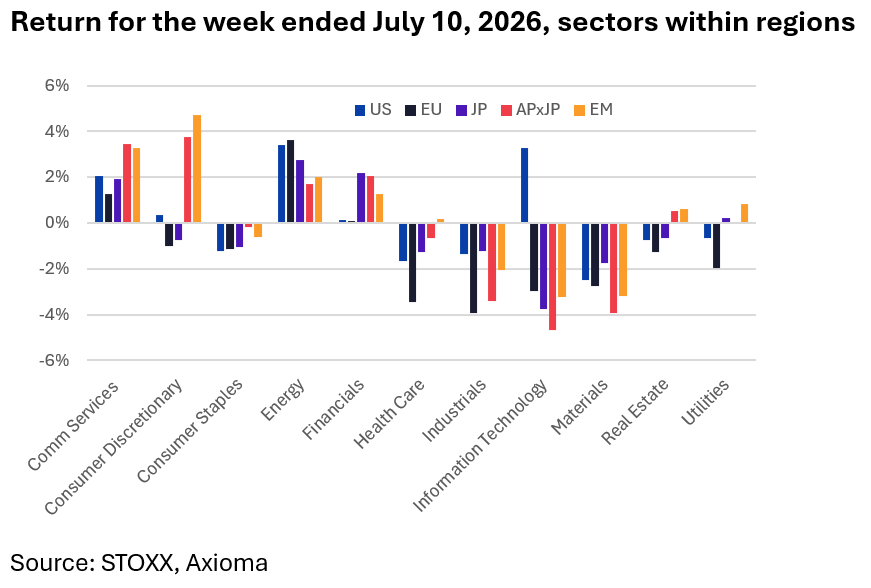
Last week saw the US equity market rise, although many other markets experienced losses. Renewed US-Iran tensions sent oil prices up, yet the enthusiasm pendulum swung back to favoring US AI and semiconductor names, while shunning Tech in other parts of the world.
Energy and Communications Services stocks were up across regions, and Consumer Staples, Industrials and Materials stocks fell, while other sectors saw mixed returns by region.
The following chart is not included in the Equity Risk Monitors, but is available on request:
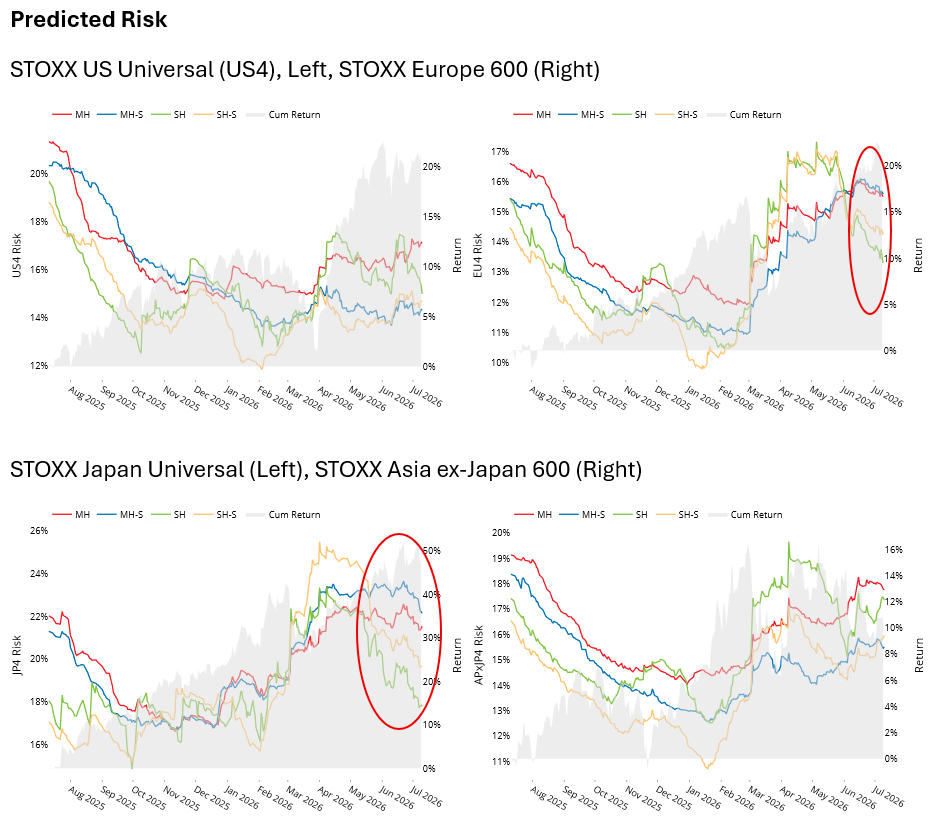
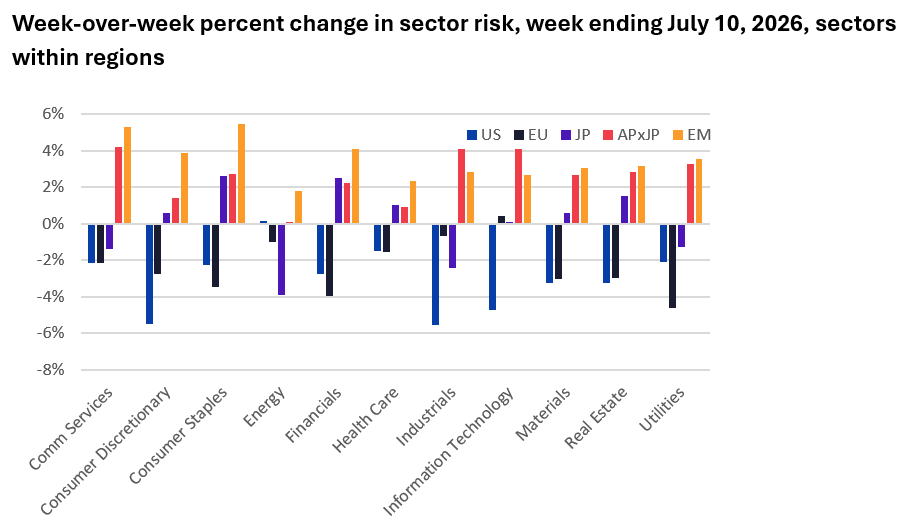
As investor sector preferences see-sawed, short-horizon fundamental risk fell in the US, Europe and Japan. The US saw the biggest proportional decline, 7%, as risk was down week-over-week in every sector except Energy, and declines were bigger in the US in most cases than they were in other regions.
We also note that in Japan, and to a smaller extent in Europe, the short-horizon statistical model has pulled ahead of its fundamental counterpart, perhaps suggesting a risk not currently seen as part of the fundamental factors.
See charts from the STOXX US, STOXX Europe 600, STOXX Japan, STOXX Asia ex-Japan, and STOXX Emerging Markets Equity Risk Monitors as of July 10, 2026
The following chart is not included in the Equity Risk Monitors, but is available on request.
Drilling down into Emerging Markets risk
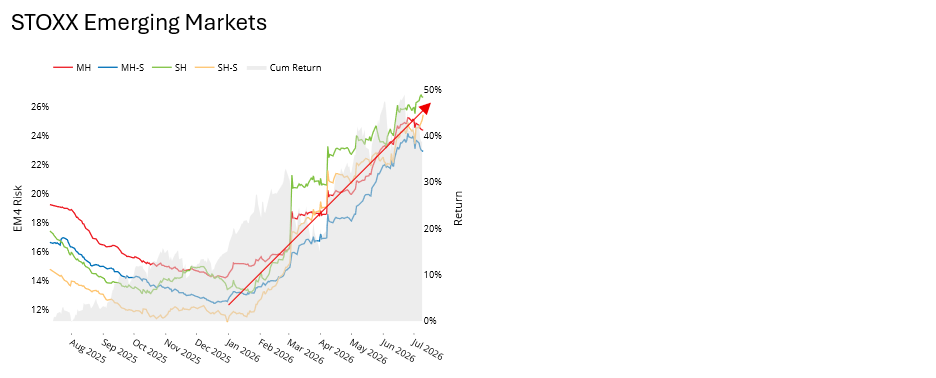
For the STOXX Emerging Markets Index, risk according to the EM4 short-horizon fundamental model rose last week from 26.3% to 26.7%. That one-week move is modest in isolation, but it sits on top of a long and steady climb. Year to date, EM risk is up 13.1 percentage points, roughly doubling proportional to its level at the end of 2025, even as risk in every other region we track has been stable (as in the US) or has risen then fallen, over the same horizons. Emerging Markets now carries by far the highest short-horizon predicted volatility of the major regions, at a level last seen for other markets during the tariff-driven turmoil that still lingered a year ago. (Japan’s medium-horizon risk is similarly above 20%, well ahead of its short-horizon readings.)
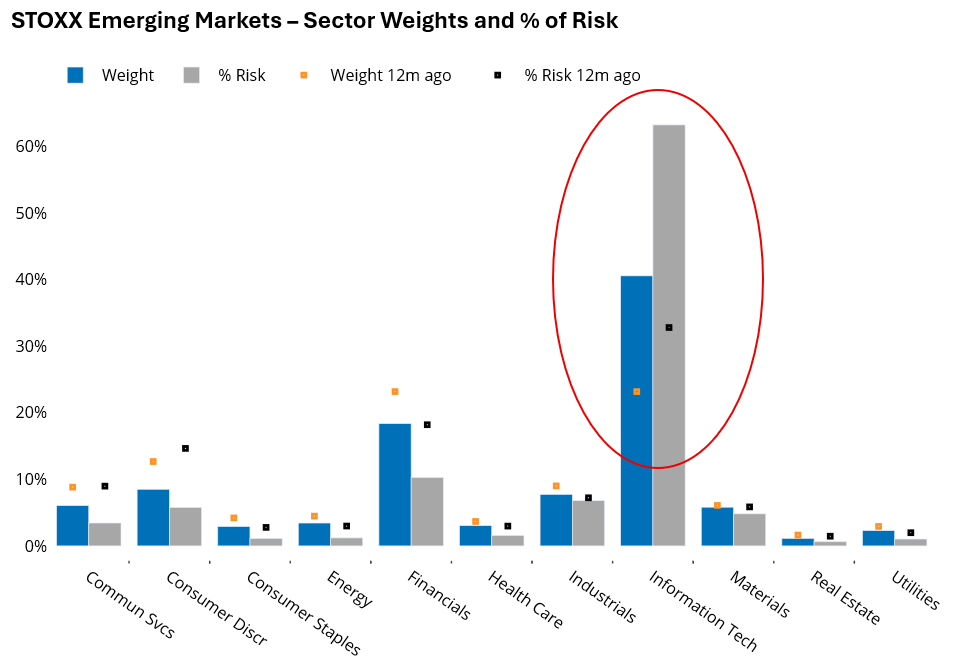
The rise in EM risk can be traced almost entirely to one sector. Information Technology now makes up more than 40% of the EM benchmark's weight, having roughly doubled its share over the past year, and the sector's predicted volatility, at over 63%, is the highest of any sector in any region we monitor closely. (Note that Technology’s weight and contribution to US risk are of similar magnitudes; the difference is that the changes from a year ago are far smaller.) For both the US and Emerging Markets, it looks less like a market where everything is struggling and more like one where a handful of giant technology names have grown so large, and so volatile, that they are now moving the indices’ risk profile on its own. Now may be a good time for Emerging Markets investors to take a close look at how much of their portfolio risk is concentrated in that one sector and decide if they are comfortable with that level of risk.
See chart from the STOXX Emerging Markets Equity Risk Monitor as of July 10, 2026
US factor performance may be causing whiplash
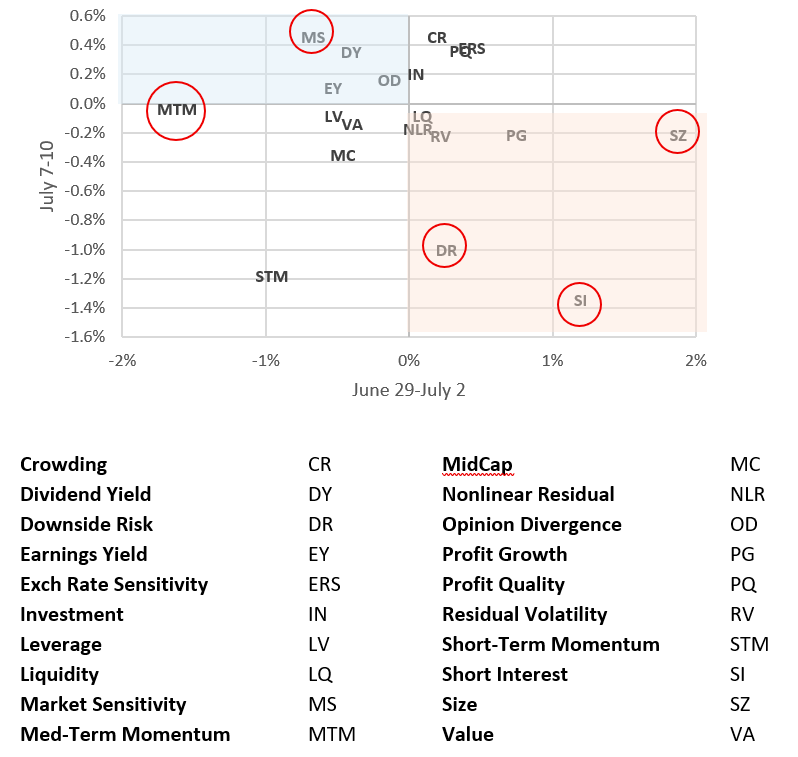
Eleven of the 20 factors in the US5.1 model experienced a sharp reversal in return from the week ending July 2 to last week. Short Interest had the biggest swing, from +1.2% in the first period (the opposite direction from expectations, likely reflecting short covering during that volatile time) to -1.3% last week. Last week the sign of the return was more in line with expectations but more importantly of a magnitude that is almost three standard deviations below the long-term five-day return. Size also saw a big reversal, from a “sizable” +1.9% to -0.2% last week. Medium-Term Momentum’s return was slightly negative last week, but was far better than the 1.6% loss the prior week, which reflected the see-sawing of investor preferences mentioned above. And, as the market moved from a weekly loss to a weekly gain, with Market Sensitivity (a beta-like factor) returned -0.7% and 0.5%, respectively. But, it also shifted from mild risk seeking to risk avoidance as reflected in the return to Downside Risk, which went from 0.3% to -1.0%.
You may also like


