

The AI Wave Exposes Emerging Markets’ Concentration Problem
Author:

AI has become the dominant force behind Emerging Markets transforming their risk profile. Taiwan and South Korea now account for nearly four-fifths of benchmark risk, while TSMC, Samsung Electronics and SK Hynix drive nearly half, leaving a benchmark of more than 2,400 stocks far less diversified than its breadth suggests.
AI has transformed Emerging Markets into an increasingly concentrated semiconductor and country risk trade.
Emerging Markets have been one of the standout equity stories of 2026. At the beginning of the year, a weaker US dollar provided an early tailwind, investor sentiment turned bullish and trading activity surged. As the year progressed, however, Emerging Markets increasingly rose and fell with the AI wave’s capricious moves.
That sensitivity reflects Emerging Markets’ central role in the physical infrastructure behind AI, particularly semiconductor manufacturing. The exposure has generated exceptional returns, especially in Taiwan and South Korea, but it has also fundamentally reshaped the risk and diversification characteristics of Emerging Markets.
What looks like a geographically diverse allocation spanning thousands of securities has increasingly behaved like an AI-hardware trade dominated by Taiwan and South Korea and concentrated in just three semiconductor companies.
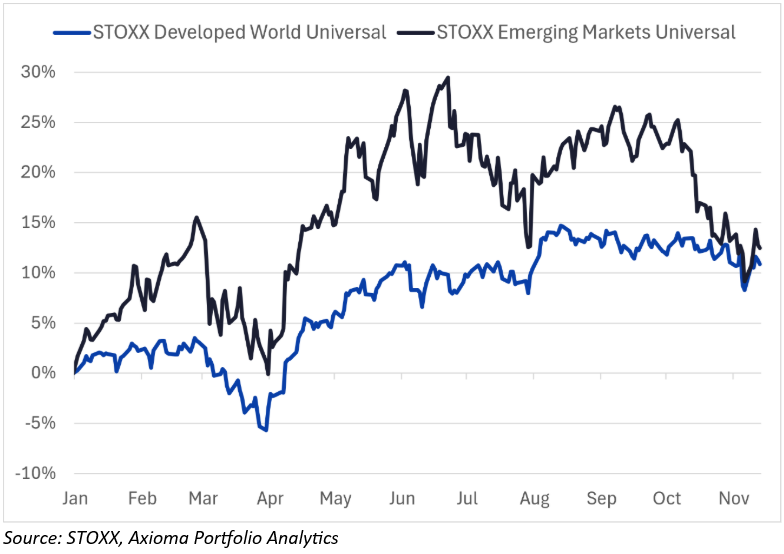
Figure 1. YTD Performance: STOXX Emerging Markets Univ. vs. STOXX Developed World Univ.
Tech has powered Emerging Markets
Technology was already at the center of Emerging Markets’ advance at the beginning of the year and has since become the dominant driver. Nearly all of Emerging Markets’ positive year-to-date return has come from the strong performance in tech.
That strength helped propel Emerging Markets ahead of Developed Markets and supported a powerful recovery following the sharp market disruption triggered by the US-Iran war. The outperformance continued by a wide margin into the fourth quarter. However, the tide began to turn in early October, with Emerging Markets losing ground fast as technology came under renewed pressure amid concerns about the sustainability of the AI boom, the Fed’s interest-rate increase and, subsequently, the US Midterm elections. Following the latest decline in Emerging Markets stocks, STOXX Developed and Emerging Markets are now close to parity.
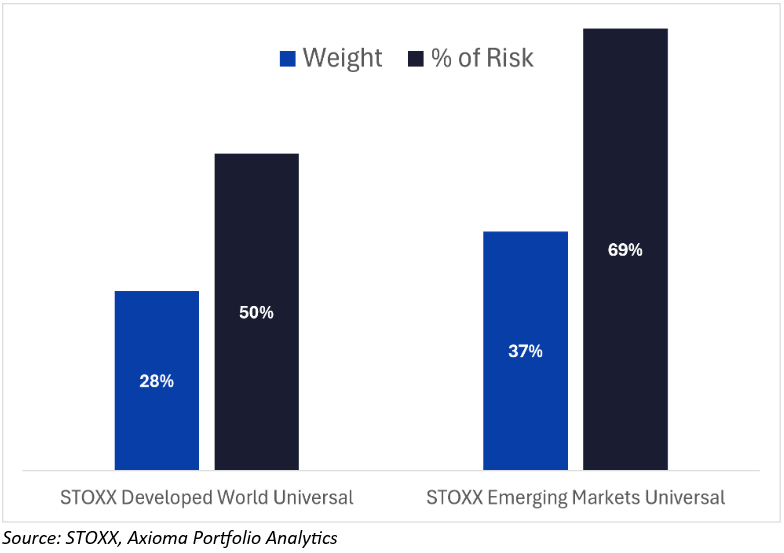
The shift is visible in the composition of the benchmark. Information Technology’s weight in the STOXX Emerging Markets Index rose 10 percentage points this year to 37%. Even more strikingly, the sector now contributes 70% to the total benchmark risk, as measured by Axioma 5.1 Fundamental Short-Horizon Model .
Technology also has a disproportionate influence in Developed Markets, but to a considerably lesser degree: it represents 28% of the STOXX Developed Markets Index and accounts for about half of its risk.
Figure 2. Sector Contribution to YTD Return
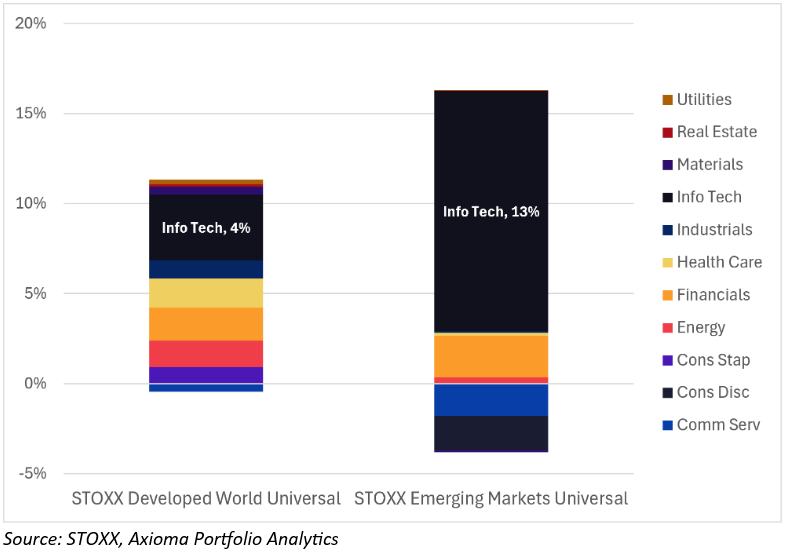
Figure 3. Information Technology Weight and % of Risk: STOXX Emerging Markets Univ. vs. STOXX Developed World Univ.
AI turned Emerging Markets into a two-country chip trade
The headline return also conceals an even more striking development: the entire year-to-date gain in Emerging Markets was attributable to Taiwan and South Korea. Both markets benefited enormously from AI-related demand and became the best-performing countries across Developed and Emerging Markets over the past year.
Their extraordinary performance progressively increased their importance within the Emerging Markets benchmark, not only in weight but, even more significantly, in their contribution to risk.
Taiwan and South Korea are no longer simply leading Emerging Markets. Together, they had become the overwhelming source of benchmark risk.
The two countries now represent 43% of the index, up 9 percentage points since the start of the year, while their combined contribution to risk has climbed from 51% to a staggering 76%, as revealed by Axioma Emerging Markets 5.1 Fundamental Short-Horizon Model. In other words, nearly four-fifths of Emerging Markets risk now comes from just two countries.
The STOXX Emerging Markets index has therefore increasingly behaved like a two-country semiconductor portfolio, reflecting Taiwan’s and South Korea’s critical positions in the global AI supply chain.
That dependence also leaves Emerging Markets particularly vulnerable when the AI trade reverses. June offered an early example, when a global semiconductor selloff hit South Korea sharply. The fourth quarter provided an even more dramatic illustration with both Taiwan and South Korea being hit hard.
Figure 4. Country weight and contribution to STOXX Emerging Markets Univ.
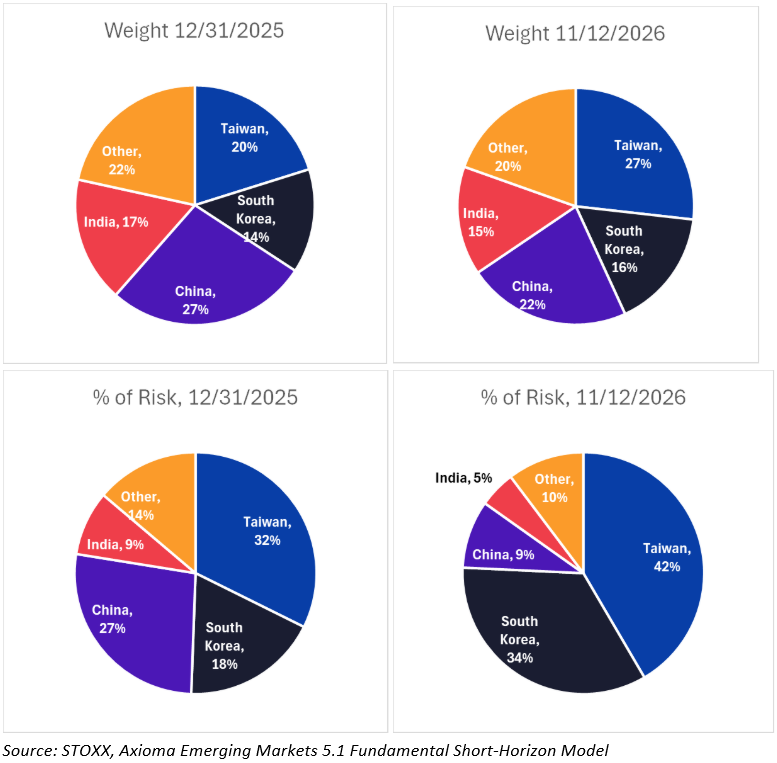
The latest technology selloff reduced South Korea’s footprint in the benchmark from 24% of the total weight at the end of June to 16% most recently. Because Korea had become both an unusually large and particularly volatile component of the index, its shrinking footprint helped tame STOXX Emerging Markets’ predicted risk.
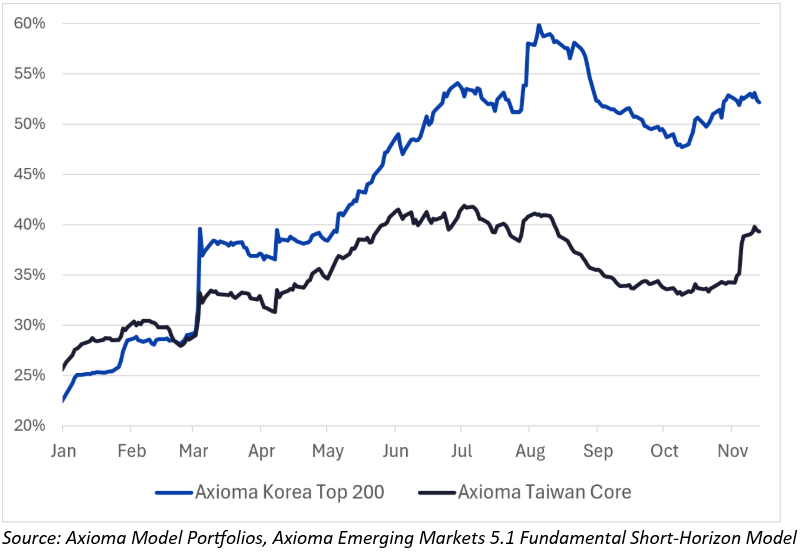
But the decline in Korea’s importance did not unwind Emerging Markets’ dependence on AI hardware. It largely shifted where that dependence resides. As Korea’s contribution receded, Taiwan increasingly took its place as the dominant source of benchmark risk.
Figure 5. Total Predicted Risk: South Korea vs. Taiwan
Taiwan and South Korea are not the same trade
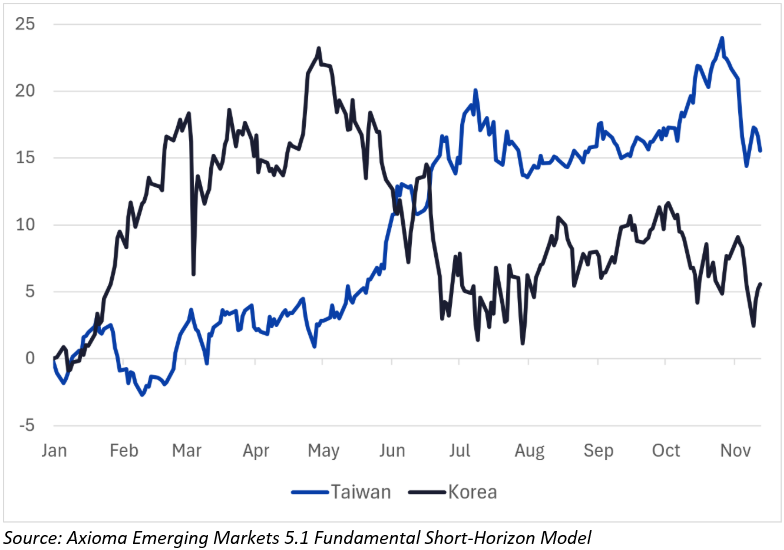
While we often think of South Korea and Taiwan as similar markets because of their shared exposure to chipmakers, they have behaved quite differently this year.
In the Axioma Emerging Markets 5.1 Fundamental Short-Horizon Model, the Taiwan and South Korea country factors capture the common behavior of each market’s stocks after accounting for broad-market, industry and style effects.
Year-to-date performance strongly favors the Taiwan country factor. Even after the latest sharp downturn, the Taiwan country factor is up 16%, outperforming the Korea country factor by 10 percentage points.
Taiwan and South Korea may share the same structural AI tailwind, but they do not represent the same risk exposure.
Figure 5. South Korea and Taiwan Country Factor Return
Thousands of stocks do not necessarily mean diversification
The Emerging Markets benchmark spans thousands of companies, countries and industries, yet its underlying risk has become far more concentrated than that breadth would suggest.
Taiwan and South Korea dominate at the country level, but the concentration becomes even more striking at the company level. Just three names, TSMC, Samsung Electronics and SK Hynix, now drive nearly half of the STOXX Emerging Markets Index’s risk, as measured by the Axioma Emerging Markets 5.1 Fundamental Short-Horizon Model
The effective number of stocks provides another way of seeing just how narrow the underlying exposure has become. Despite having more than 2,400 constituents, the STOXX Emerging Markets Index had an effective stock count of only 37. From a concentration perspective, therefore, the benchmark behaves more like a portfolio of 37 equally weighted securities than one containing thousands of stocks.
The comparison with Developed Markets is revealing. The STOXX Developed Markets Index is itself concentrated, in part because of the dominance of the US market. Yet its effective number of stocks is 94, despite having nearly 1,000 fewer constituents than its Emerging Markets counterpart.
For asset allocators, the implication is important: a portfolio can appear highly diversified by constituent count while still deriving much of its performance and risk from a remarkably narrow set of names.
The risk profile behind Emerging Markets exposure
AI-related investment has provided a powerful tailwind to some of the region’s largest companies and helped propel Emerging Markets ahead of many Developed Markets. But the same forces that fueled those gains have also transformed the STOXX Emerging Markets benchmark, leaving its risk profile far more concentrated than its more than 2,400 constituents would suggest.
The Axioma Emerging Markets 5.1 Fundamental Short-Horizon Model illustrates the extent of that transformation. Taiwan and South Korea account for almost four-fifths of benchmark risk, while a remarkably large share is concentrated in just three companies: TSMC, Samsung Electronics, and SK Hynix.
The fourth-quarter selloff adds another important dimension: concentration is not static. Korea’s declining weight temporarily helped reduce aggregate Emerging Markets risk, but it did little to loosen the benchmark’s dependence on AI hardware. Instead, that exposure shifted increasingly toward Taiwan and, to a remarkable degree, TSMC.
For investors, the most important question may therefore no longer be simply whether to allocate to Emerging Markets. It is what exposure an Emerging Markets allocation actually provides.
Today, the answer is considerably less diversification than either the benchmark’s name or its constituent count might suggest: a substantial AI-hardware exposure concentrated in two countries and a handful of companies, with meaningful differences in the risks represented by each.
You may also like


