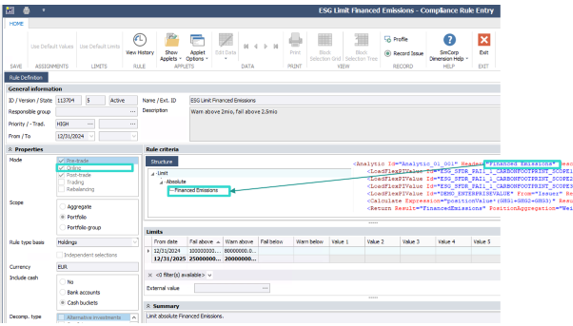
The Online Compliance applet can now handle rules that use Flexible Analytics. The compliance or ESG officer can now run intraday compliance checks using Flexible Analytics.
Figure 1 Compliance online mode for Flexible Analytics
Subscription based licensing
ESG Investing
Sales module dependency
ESG Investing
Flexible Analytics enhancements for securitized products
The enhancement introduces Current Face value as new position value in the Flexible Analytics engine. This facilitates reporting instrument types reflected as “Securitization and structured products” (SSP) for standards like Partnership for Carbon Accounting Financials (PCAF).
This enhancement allows you to:
Configure Flexible Analytics, e.g. ESG KPIs for US Pools using Current Face Value, as reserved variable to reflect the Current Outstanding Amount.
Configure Flexible Analytics, e.g. ESG KPIs for US Pools via the expanded PositionValue statement via CurrentFaceValueSegment to reflect the Current Outstanding Amount.
The Current Outstanding Amount (COA) is the numerator in the collateral attribution factor and therefore required for correctly calculating the financed emissions according to PCAF V3 (2025) for the asset class as “Securitization and structured products” (SSP).
Outcome
You can now produce KPIs for Securitization and structured products for ESG standards like PCAF aligned financed emissions reporting with their correct position value.
Figure 1 Current Face Value
Subscription-based licensing
Corporate Actions Manager, TM Total Return Swap
Sales module dependency
Corporate Actions Manager, TM Total Return Swap
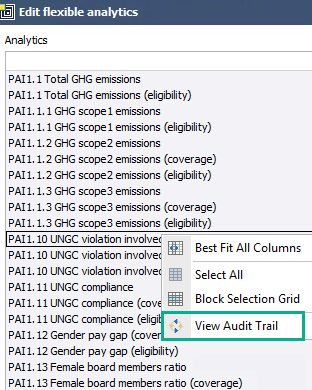
Audit trail directly in Flexible Analytics Editor & expansion of filter options
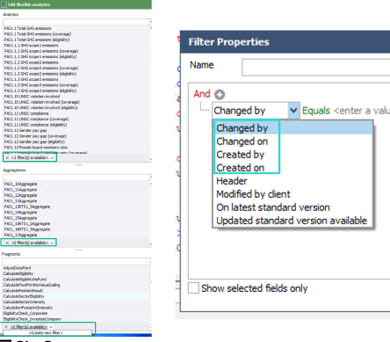
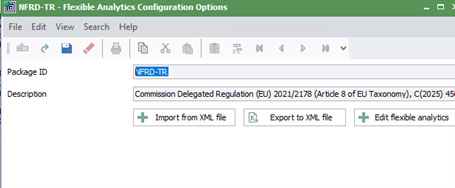
The audit trail is now directly accessible from the Flexible Analytics Editor (Flexible Analytics Configuration Options). Further, the filter properties have been expanded to now also cover: Changed by, changed by, created by, and created on. Also, the fragments now have filter properties enabled.
With the Audit trail accessible in the Flexible Analytics Editor, the ESG analyst can now directly check, at the analytic or package level, which analytics, aggregates, or fragments have been changed, how (i.e., see before-and-after changes to the XML), by whom, and when.
Figure 2: View Audit Trail Editor
These enhancements enable you to:
Directly in the Flexible Analytics to understand the changes applied to the analytic(s), aggregation and/or fragment of interest, validate who changed it and when
Filter for users who changed one or more Flexible Analytic
Filter for dates at which one or more Flexible Analytics were changed
Filter for users who created one or more Flexible Analytic
Filter for dates at which one or more Flexible Analytics were created
Subscription-based licensing
Corporate Actions Manager, TM Total Return Swap
Sales module dependency
Corporate Actions Manager, TM Total Return Swap
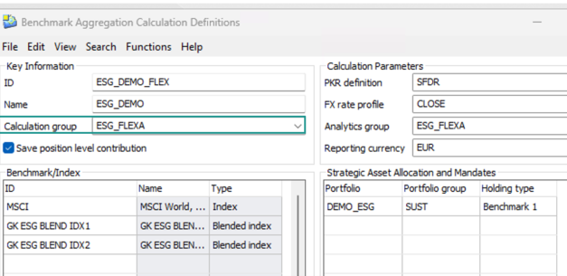
Calculation Group added for Benchmark Aggregation Calculation
The Benchmark Aggregation Calculation Definition has been expanded with the “Calculation Group” functionality. With this enabled, the user can filter benchmark aggregations in the Data Warehouse by calculation group. This enhancement replaces cumbersome manual filtering with dynamic filtering based on an existing calculation group setup.
Figure 4: Benchmark Aggregation Calculation Group
Subscription-based licensing
Corporate Actions Manager, TM Total Return Swap
Sales module dependency
Corporate Actions Manager, TM Total Return Swap
ESG Standard for SFDR-PAI Update due to EET Update
The European ESG Template (EET) has been updated by FinDatEx to Version 1.1.3 in relation to NACE 2.1. In Nace 2.1, Real Estate is now section M instead of L. This changes naming conventions for SFDR PAI 1.6 sector L, which is now renamed to the new sector name M. The Flexible Performance Indicator Definitions are also updated accordingly to the new naming convention.
Flexible Analytics enhancements for Loan Facilities
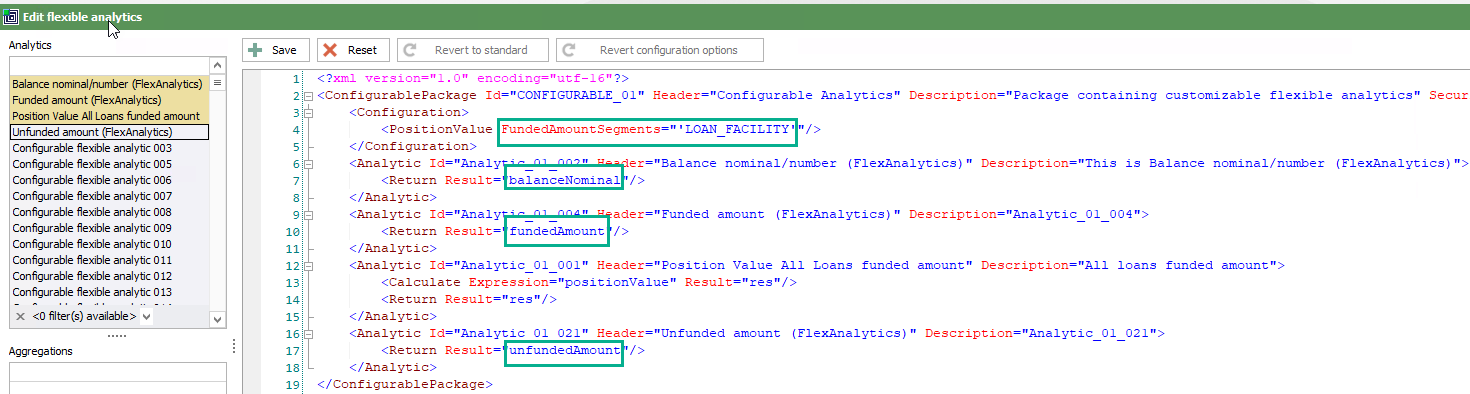
The enhancement introduces funded and unfunded amounts as new position values for loan facilities. This facilitates reporting instrument types reflected as Loan facilities for standards like Partnership for Carbon Accounting Financials (PCAF).
This enhancement allows you to:
Configure Flexible Analytics, i.e. ESG KPIs for loans using fundedAmount, unfundedAmount, and balanceNominal as reserved variables.
Reflect these values in flexible analytics via the expanded PositionValue statement supporting:
FundedAmountSegments
UnfundedAmountSegments
Outcome
You can now produce KPIs for loan facilities for ESG standards like PCAF aligned financed emissions and PCAF-aligned undrawn loan commitment reporting for loan facilities with their correct position value.
Caption: Funded and unfunded amount
Subscription based licensing
ESG Investing
Sales module dependency
ESG Investing
Expansion of Freely Available Flexible Analytics
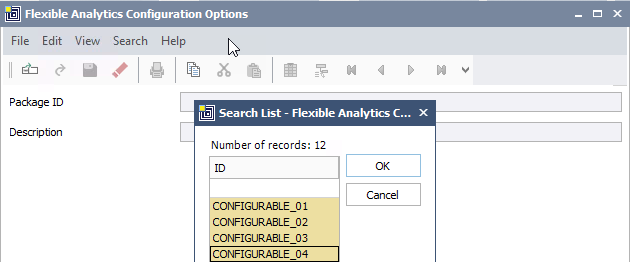
This enhancement expands the total capacity of flexible analytics significantly. You now have access to up to 300 configurable flexible analytics in each of four freely available packages: Configurable_01 - Configurable_04.
Also, all existing packages have been expanded with the double amount of freely available Flexible Analytics.
This expansion enables you to:
Define substantially more ESG analytics tailored to internal and regulatory ESG requirements outside SimCorp Standards,
Configure advanced custom logic,
Use these analytics seamlessly across Asset Manager,ComplianceManager, and AggregationCalculation and BenchmarkAggregation.
Create variations of existing standards in new Flexible Analytics.
Outcome
You gain a scalable, future proof ESG analytics framework capable of adapting to expanding ESG data, KPI frameworks, and regulatory obligations.
Subscription based licensing
ESG Investing
Sales module dependency
ESG Investing
Release 26.01
Support for check of Business Classification in Flexible Analytics Editor editor in “Condition” and “Eligibility” statements
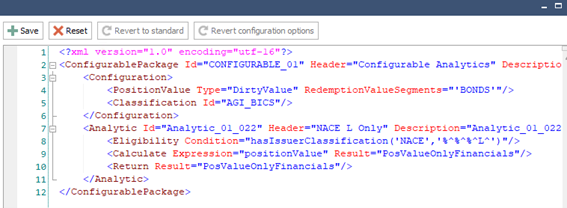
Users can now define Flexible Analytics in the Editor which are based on either its Security’s or its Issuer’s Business Classification. The Business Classification criteria can be used in the “Condition” and/or “Eligibility” statement. For example, this enhancement allows the user to calculate a KPI for a specific NACE selection (e.g. financials) which is required in the NFRD omnibus regulation.
Benefits
Enables users to define Flexible Analytics with additional requirements based on Security or Issuer Business Classification.
The additional check can be used in either “Condition” or “Eligibility” statements in the Flexible Analytics Editor.
NFRD Omnibus requires a differentiation of Financial and Non-Financials in certain KPIs. This is reflected via NACE Business Classification, which can now be used in the Flexible Analytics Editor.
Caption: hasIssuerClassification Editor Statement
Caption: hasIssuerClassification Editor Statement
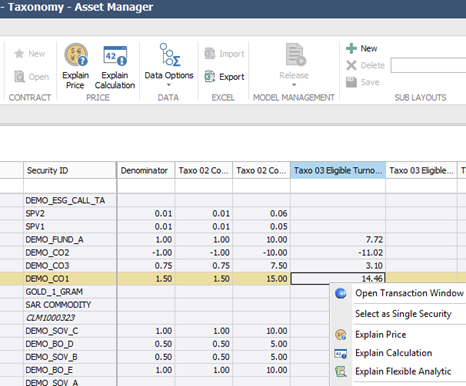
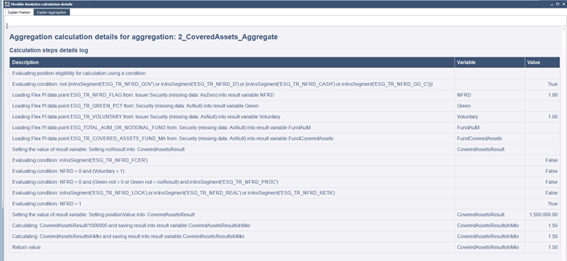
Explain Flexible Analytics of aggregate in Asset Manager
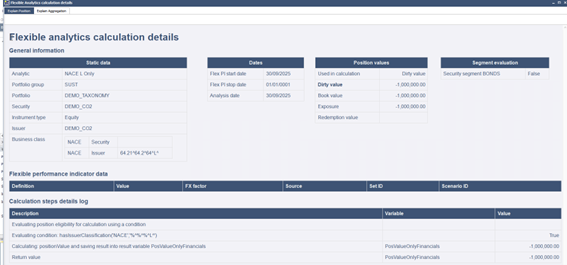
With 26.01 the user can easily validate Flexible Analytics aggregation result on a position level of in the Asset Manager. The “Calculation steps details log” is now also enabled on a position level for the aggregation result. That helps the user to follow the calculation logic stepwise and identify potential missing data points or configuration and thereby validate ESG figures calculated in SimCorp Dimension.
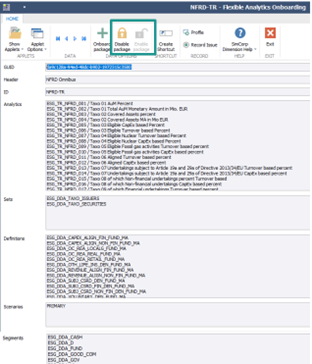
The offboarding of Flexible Analytics Packages allows the user to disable previously onboarded Flexible Analytics standard packages that are either not needed any longer (e.g. because a new regulation is substituting an old) or momentarily not required. This enables the user to continue using the Flexible Analytics Service even with some configurations from offboarded packages missing.
Benefits
Users can streamline their Flexible Analytics by disabling Flexible Analytics packages that are no longer relevant, reducing clutter and focusing only on necessary regulatory requirements.
It provides operational flexibility, allowing users to re-enable previously offboarded packages as business needs or regulatory requirements change.
The service remains operational and effective even when certain (offboarded) package configurations are missing, ensuring uninterrupted analytics capabilities while adapting to evolving requirements.
Caption: Flexible Analytics Offboarding 1
Subscription based licensing
ESG Investing
Sales module dependency
ESG Investing
NFRD-TR (Omnibus) Disclosure Delegated Act Taxonomy Article 8 package available as Flexible Analytics
The new standard package “NFRD-TR” contains the pre-configured ESG analytics for the regulatory requirements set in the Commission Delegated Regulation (EU) 2021/2178 (Article 8 of EU Taxonomy), C(2025) 4568 from July 4 2025. It comprises 64 analytics for Annex X and 60 analytics for Annex IV with 12 breakdowns (of the other counterparties KPIs).
Benefits
Comply with most recent regulatory updates
Consistent solution across packages using the Flexible Analytics Editor
Easily adjustable for custom requirements using xml
Caption: Flexible Analytics Offboarding 1
Subscription based licensing
ESG Investing, NFRD-TR
Sales module dependency
ESG Investing, NFRD-TR
Release 25.10
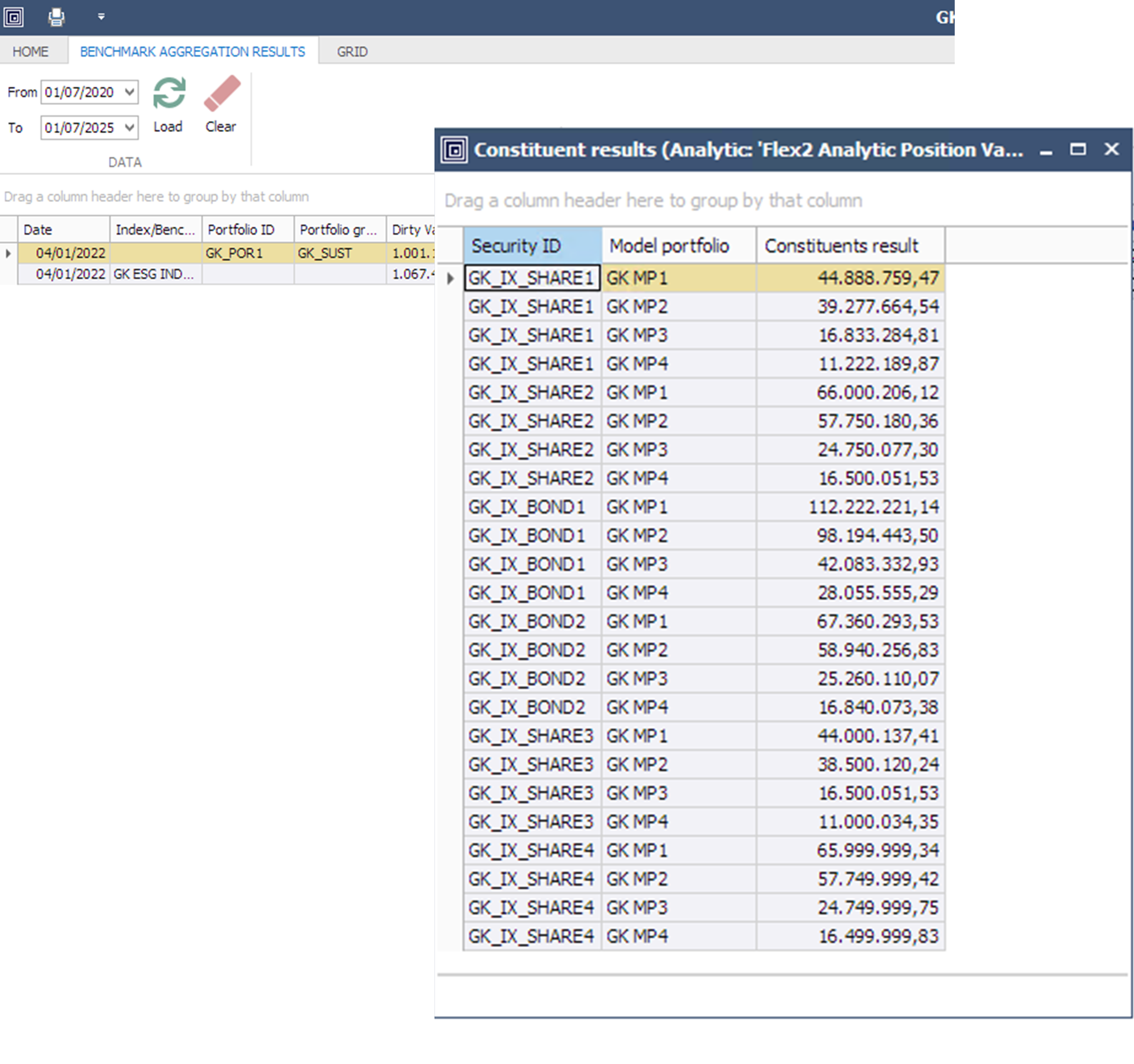
Benchmark aggregation calculation – save constituents’ ESG contribution to database and view both aggregated and position result in SCD
Users can now validate ESG results at the level of benchmark constituents. This enhancement provides transparency into how each constituent contributes to the overall FlexAnalytic, enabling more accurate reporting. Next to being able to extract the constituent and aggregated results, the user can now in SCD see both aggregated and constituent results in a results screen.
Benefits
Enable granular validation of ESG metrics at the benchmark constituent level.
Improve transparency and auditability of ESG results for compliance and reporting.
Subscription based licensing
ESG Investing
Sales module dependency
ESG Investing
Redemption value as new Position Value
Flexible Analytics now supports Redemption Value as a Position Value option, enabling more accurate investment assessments in, for instance, SFDR reporting. For bond instruments, this enhancement ensures that the “current value of investment” reflects the book value of debt owed by the borrower, aligning with SFDR requirements. This allows users to correctly calculate the ratio of current value of investment to the investee company’s enterprise value, improving the precision and compliance of ESG disclosures.
Benefits
Enable redemption value as position value for a defined set of instruments, including bonds.
Improve accuracy of SFDR-related metrics by aligning with regulatory expectations.
Support ESG reporting flows through the correct application of position value for bonds in investment calculations
Subscription based licensing
ESG Investing
Sales module dependency
ESG Investing
Added support for FlexPI data with any currency in FlexAnalytics
Flexible analytics now fully supports automatic currency conversion for ESG metrics when the data point currency differs from the reporting currency. This ensures accurate and consistent results across multi-currency portfolios without manual intervention. Before, this was possible for UDKRs, now it is also possible for FlexAnalytics.
Benefits
Enable seamless ESG analytics across currencies with automatic FX conversion.
Save time and reduce errors by eliminating manual currency adjustments.
Improve accuracy of ESG reporting in global investment contexts.
Subscription based licensing
ESG Investing
Sales module dependency
ESG Investing
Improvements of the “Explain Flexible Analytics” in the Asset Manager
There are multiple enhancements to the “Explain Flexible Analytics” feature in 25.10 in the Asset Manager.
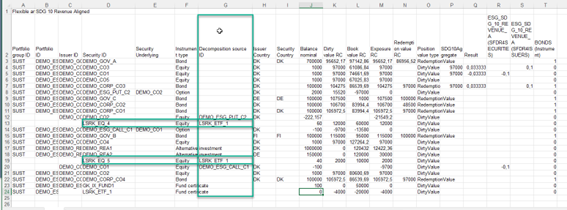
The Asset Manager’s “Explain Flexible Analytics” functionality now enables faster and more reliable validation of fund and benchmark constituents, and model portfolio positions. Enhancements to the .csv output provide meaningful static data information of the decomposed security ID of the fund, the benchmark constituent, and the model portfolio position. For decomposed fund certificates, their decomposition source is added as an additional column in the .csv file.
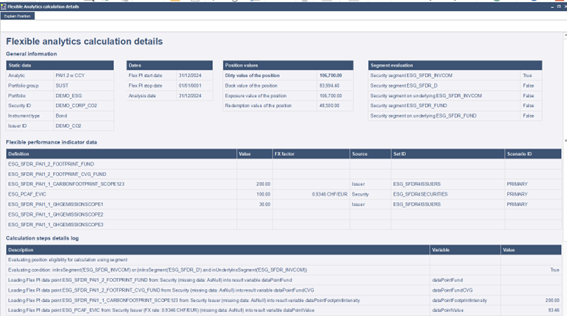
Further, “Flexible Analytics calculation details” in the Asset Manager is now more comprehensive and includes more validation data, like e.g. FlexPI data and FX rate, Segment evaluation, Flex PI start and stop dates.
Subscription based licensing
ESG Investing
Sales module dependency
ESG Investing
SDG (Sustainable Development Goals) package available as FlexAnalytics
The SDG standard package enables users to integrate 240 pre-configured ESG analytics and 20 configurable placeholders into their flexible analytics setup. This ensures consistency across SDG, SFDR, and NFRD-TR frameworks, reducing the need for manual configuration and improving time-to-value for ESG reporting.
Benefits
Enable consistent ESG reporting across regulatory frameworks using a standardised analytics package.
Save time by eliminating the need to manually configure SDG metrics.
Optimise ESG onboarding with a scalable and centrally maintained analytics package.
Subscription based licensing
ESG Investing, SDG Alignment
Sales module dependency
ESG Investing, SDG Alignment
Release 25.07 ESG
Issuer-level netting treatment for long and short exposures
You can now ensure SFDR-compliant sustainability reporting by automatically netting long and short positions—including derivatives—at the issuer level, with a zero-floor logic that prevents negative exposures from distorting principal adverse impact (PAI) indicators.
This enhancement follows the latest Q&A guidance from the European Supervisory Authorities (ESAs), ensuring that all exposures linked to the same issuer are grouped and netted, and that any resulting negative total exposure is floored at zero. This treatment applies consistently across equities, debt instruments, and derivatives, using the issuer of the underlying for derivative positions.
While this logic is designed to support SFDR PAI calculations, it is also available for use in other analytics contexts where issuer-level netting is relevant. The setting is turned on by default in the SFDR PAI FlexAnalytics package, ensuring immediate compliance and consistency across sustainability reporting workflows.
Benefits
Ensure compliance with SFDR by applying issuer-level netting and zero-floor logic for negative exposures.
Avoid overstating adverse impacts from short or hedged positions by neutralizing net short exposures in PAI calculations.
Extend analytical flexibility by applying the same netting logic to other use cases beyond SFDR, supporting broader ESG and risk analytics.
Subscription based licensing
ESG Investing
Sales module dependency
ESG Investing
Store proxy ESG and fundamental data in FlexPI at business classification level
You can now store ESG and fundamental data in the Flexible Performance Indicator (FlexPI) repository at business classification levels 3, 4, and 5. This allows you to use proxy data for industry averages in Flexible Analytics—enabling analytics to fall back to sector-level values when data is missing at the security or issuer level.
For example, if emissions data is unavailable for a specific security and its issuer, the system can retrieve an industry average from the corresponding business classification, such as a NACE sector. This ensures broader data coverage and supports more consistent ESG and fundamental reporting across your portfolios.
Benefits
Enable fallback logic for ESG and KPI data Retrieve data from business classification levels when security or issuer-level data is missing, ensuring continuity in analytics.
Use proxy data for industry averages Apply sector-level values (e.g., NACE) to fill data gaps, improving completeness and comparability in ESG and fundamental metrics.
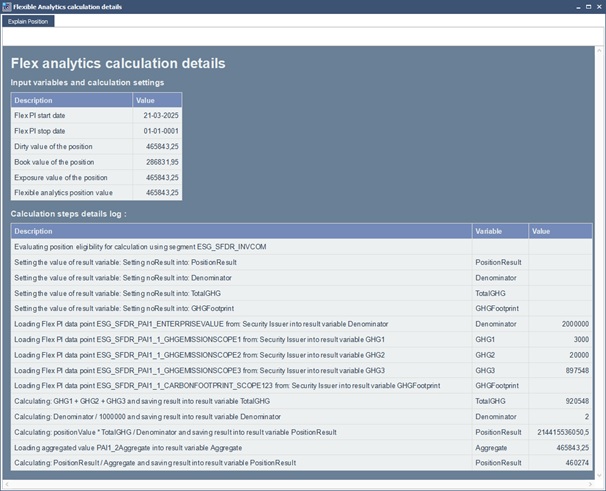
You can now fully trace how ESG and fundamental values are calculated in Flexible Analytics using the enhanced Explain ESG functionality. This feature brings radical transparency to your data—giving you a step-by-step breakdown of how each analytic value is derived, directly from the Asset Manager.
By right-clicking on any value and selecting Explain Flexible Analytic, you’ll see a detailed walkthrough of the entire calculation process—from data inputs and variable configurations to the final computed result. Whether you're working with standard or custom analytics, this enhancement helps you confidently validate and explain every number.
Think of it as having a developer sitting next to you, walking you through the logic behind the scenes — but without needing to read a single line of code.
Enhanced Explain Flexible Analytic.
Benefits
Enable full traceability of ESG and fundamental values Understand exactly how each analytic is calculated, from raw data to final result.
Build trust and confidence in your analytics Easily validate ESG metrics and explain them to stakeholders, auditors, or clients.
Support both standard and custom analytics Get transparency across all analytic types—no matter how tailored your setup is.
Subscription based licensing
ESG Investing
Sales module dependency
ESG Investing
Coverage and eligibility analytics for SFDR-PAI
To support more transparent and structured ESG reporting — including fund-level disclosures alignedwith the European ESG Template (EET) — each SFDR Principal Adverse Impact (PAI) analytic now comes with two optional companion analytics: one for eligibility and one for coverage. These analytics help you assess how much of your portfolio is in scope for a given PAI, and how much of that scope is actually covered by data.
While both coverage and eligibility are voluntary, they are valuable tools for understanding data completeness and improving the quality of your disclosures. The coverage logic now aligns with the methodology defined in the EET, which is widely adopted across the industry.
For example, in a portfolio of 100 equally weighted positions:
50 positions are eligible for a specific PAI
20 of those eligible positions have valid data
The new coverage calculation is:
Coverage = Positions with data / Total portfolio value = 20 / 100 = 20%
This differs from the previous logic, which would have calculated:
Coverage = Positions with data / Eligible positions = 20 / 50 = 40%
If needed, the calculation logic can be adjusted via configuration to reflect your preferred methodology.
Benefits
Gain deeper insight into ESG data quality Use out-of-the-box eligibility and coverage analytics to assess how much of your portfolio is in scope and how much is backed by actual data.
Support fund-level ESG reporting aligned with the EE Meet industry expectations for standardized, transparent disclosures across portfolios.
Subscription based licensing
ESG Investing
Sales module dependency
ESG Investing
SFDR-TR as Standard Package within the Configurable Flexible Analytics framework
Streamlined integration with Standard Package Configuration
With version 25.07, the SFDR-TR standard package is now available as part of the Configurable Flexible Analytics (FlexAnalytics) framework. This package supports periodic reporting for Articles 8 and 9 products under the SFDR regulation, based on the KPI definitions in Annexes IV and V of the SFDR RTS. Delivered as part of the SimCorp Dimension release, the standard package enables efficient onboarding and ensures consistency across updates. As with other standard packages, it includes both preconfigured and freely configurable analytics, allowing for client-specific customization where needed.
Comprehensive EU Taxonomy KPI coverage
The package includes a broad set of EU Taxonomy-aligned KPIs, covering:
Investment-level breakdowns for Articles 8 and 9 products, including sustainable, environmental, and social dimensions.
Revenue, CapEx, and OpEx alignment metrics across all objectives, with or without sovereign exposure.
Detailed activity classifications, including enabling and transitional activities, with numerator-level granularity.
Revenue alignment KPIs for each of the six environmental objectives under the EU Taxonomy.
Subscription based licensing
ESG Investing
Sales module dependency
ESG Investing SFDR
Release 25.04 ESG
Flexible Analytics integration into Benchmark Aggregation Calculation
Achieve comprehensive ESG Reporting on benchmark level
With version 25.04, you can now leverage flexible analytics for ESG reporting on benchmark level. This enhancement expands ESG metrics beyond User Defined Key Ratios (UDKR)-based metrics, ensuring that benchmark aggregations are also available for flexible analytics.
Subscription based licensing
ESG Investing
Sales module dependency
ESG Investing
Configure Earliest Cut-Off Date for Using ESG Data
Ensure accurate ESG Reporting with configurable cut-off dates
With version 25.04, you can now configure the earliest cut-off date for fetching FlexPI data used in FlexAnalytics calculations. This enhancement ensures your ESG reports are based on the most relevant and current information, helping you avoid outdated data.
Flexible configuration for cut-off dates
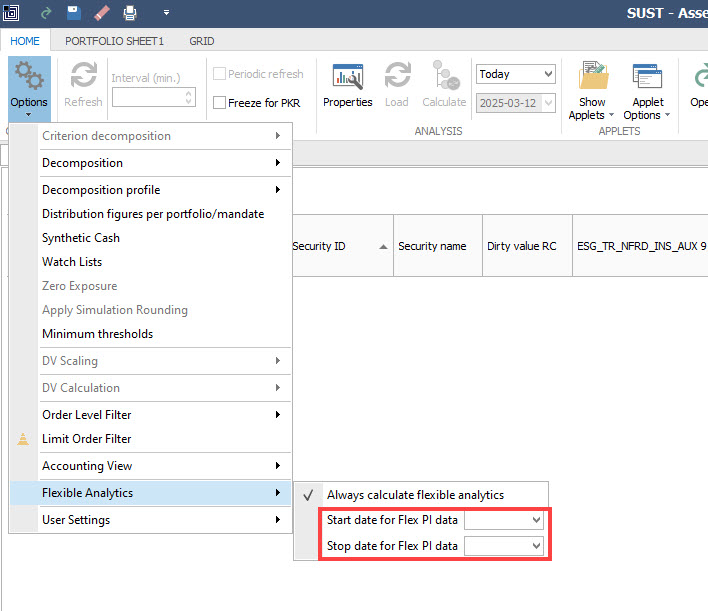
You can configure the cut-off dates for FlexPI data in several places:
In a batch job setup where the Batch task field is set to Aggregation Calculation - Calculate or Benchmark Aggregation Calculation - Calculate.
In Asset Manager, under Options > Flex Analytics.
In Compliance Manager in the Compliance Configuration window.
Asset Manager Start date and Stop date
To configure the dates: To set the earliest cut-off date, enter a date or reference date (only in batch jobs) in the Stop date for Flex PI data field. The default setting is the earliest possible date, meaning all applicable FlexPI data is used regardless of age. When using a reference date, it is relative to the analysis date.
To set the latest cut-off date, previously known as "Max. date for Flex PI data," enter a date or reference date in the Start date for Flex PI data field. The default setting remains the analysis date, as before.
These enhancements provide comprehensive and accurate ESG reporting capabilities, ensuring compliance with regulatory requirements and supporting your sustainability goals.
Subscription based licensing
ESG Investing
Sales module dependency
ESG Investing
Added Re-Usable Fragments in Configurable Flexible Analytics
Enhance efficiency and consistency with re-usable fragments
With version 25.04, you can now insert re-usable fragments in your configurable flexible analytics setups. This enhancement makes your analytics setups more efficient, consistent, and easier to maintain. By encapsulating recurring code in a fragment, you can re-use this piece of code wherever it is required. If the configuration of this code changes, you only need to edit it in a single place, streamlining maintenance.
Flexible fragment configuration
Fragment tags can include Set, CalculationCases, Calculate, and LoadFlexPiValue. However, they cannot contain Eligibility statements, as one package can contain several fragments. This flexibility allows you to create modular and reusable components within your analytics setups.
Simple integration of fragments
To insert a fragment into a flexible analytics definition, reference it by its unique ID attribute at the package level in analytics and aggregations. This straightforward integration ensures that analytics setups remain organized and maintainable.
These enhancements make analytics processes more efficient and consistent, supporting overall data management and reporting goals.
Subscription based licensing
ESG Investing
Sales module dependency
ESG Investing
SFDR (RTS1.0 and draft RTS1.5) as Standard Package within the Configurable Flexible Analytics framework
Added SFDR standard package for configurable flexible analytics
Efficient onboarding with standard package configuration
With version 25.04, you can now integrate SFDR analytics into a standard package of configurable flexible analytics. The standard package configuration is part of the SimCorp Dimension release, ensuring fast and seamless onboarding. Updated standard package configurations can be released with SimCorp Dimension updates, keeping your analytics current and compliant. Additionally, a standard package can contain analytics without configuration, known as Configurable analytic SFDRAnalytic, which are freely configurable.
Comprehensive SFDR analytics
The FlexAnalytics solution includes the 11 Principal Adverse Impacts (PAIs) present in SFDR RTS1.5 (in draft state from December 2023). Some data providers deliver precalculated intensities (e.g., Carbon footprint as a single data point), while others deliver the individual data points required to calculate intensities (e.g., Carbon footprint as four data points: GHG Scope 1, GHG Scope 2, GHG Scope 3, EVIC). We support both versions as standard, with a fallback from the first option to the second option.
Subscription based licensing
ESG Investing, SFDR-PAI
Sales module dependency
ESG Investing, SFDR-PAI
Release 25.01 ESG
Extended Configurable Analytics functionality to support standard packages of analytics
Achieve greater flexibility with standard package configurations: Starting with version 25.01, standard analytics packages are now delivered through the configurable FlexAnalytics framework. This enhancement allows you to examine and adjust the calculation logic as needed.
Effortlessly verify analytic status: Quickly determine the status of each analytic using new filter options. Whether identifying modified analytics, ensuring compliance with the latest standards, or finding analytics ready for safe upgrades, these filters provide clarity and control.
Country-level data integration: Fetch country-level data seamlessly within Configurable FlexAnalytics. The From attribute now supports multiple levels, including SecurityCountry and IssuerCountry, allowing you to configure data retrieval precisely to your needs.
Streamlined ESG reporting with aggregations: Leverage new aggregation capabilities to calculate and consolidate values for ESG reporting. This feature supports comprehensive analytics, such as denominators in the SFDR context, enhancing both reporting accuracy and efficiency.
Advanced aggregation by issuer or country: Aggregate your analytics by issuer, issuer country, or security country, and view the consolidated data in Asset Manager. Configurable via the GrandRuleType attribute, this functionality groups and presents analytics meaningfully, supporting reporting under SFDR PAI 1.16.
These enhancements are designed to provide you with more control, precision, and efficiency in your ESG analytics processes.
Revert to standard functionality available in the FlexAnalytics editor.
Subscription based licensing
ESG Investing
Sales module dependency
ESG Investing
Out-of-the box support for ESG calculations at derivative level
Starting with version 25.01, our configurable flexible analytics for ESG reporting now support derivatives. This expanded scope ensures comprehensive entity-level disclosure by converting derivatives into equivalent positions in their underlying assets, meeting SFDR reporting requirements and aligning with other ESG regulations.
In practice, for derivatives, Exposure will be used as the position value, with ESG data retrieved from the underlying assets. To enable this, the file format definition for configurable flexible analytics has been extended to include a Configuration tag, which allows for a derivatives segment declaration of eligible instruments.
 Online Compliance support for Flexible Analytics