IBOR
Release 26.10
 Publish Date Support for Consumer Price Indices (CPI)
You can now manage and use CPI publish dates alongside index values, enabling more accurate representation of when inflation data becomes available to the market and supporting workflows that depend on publication timing.
Benefits
Accurate CPI publication information is essential for inflation-linked instruments, regulatory reporting, performance calculations, and validation of market data used in valuation processes. By capturing publish dates directly with CPI data, users can better align calculations and analyses with the actual availability of inflation information.
This enhancement provides greater transparency into inflation data timelines and supports organizations that need to distinguish between an index's effective date and the date on which the information becomes publicly available.
Why This Is Valuable
- Managing inflation-linked bonds and other CPI-linked instruments.
- Supporting validation and reconciliation of historical inflation data.
- Performing analyses that depend on the timing of economic data releases.
- Meeting audit, regulatory, or governance requirements where data publication timing must be documented and traceable.
Subscription-based licensing
Inflation Linked Bonds
Sales module dependency
No dependency
Yield Book Integration
You can benefit from a series of Yield Book integration enhancements that expand analytics coverage, improve consistency across supported instruments, and provide broader access to industry-standard fixed income and structured product analytics within SimCorp Dimension.
Business value
These enhancements provide portfolio managers, risk managers, and analysts with deeper insight into how portfolios may respond to changing market conditions. By making a broader range of Yield Book analytics available within investment workflows, users can better understand risk exposures, validate valuation results, and make more informed investment decisions.
A key benefit is the ability to analyze the impact of interest rate movements through yield curve sensitivities and Yield Book Dial shocks. This allows investment teams to evaluate how securities and portfolios react under different market scenarios, supporting risk management, portfolio construction, stress testing, and investment decision-making.
The enhancements also strengthen support for fixed income and securitized products by providing greater access to specialized Yield Book measures used across the investment industry. This helps organizations apply consistent analytics across valuation, risk, and reporting processes while leveraging market-standard methodologies.
Why This Is Valuable
- Assessing portfolio exposure to interest rate and yield curve movements.
- Performing scenario analysis and stress testing using Yield Book Dial shocks.
- Understanding the sensitivity of securities and portfolios to changes in market assumptions.
- Supporting investment decisions for mortgage-backed, asset-backed, and other structured finance products.
- Validating risk and valuation results using industry-recognized fixed income analytics.
Customer Benefits
- Ability to evaluate the impact of yield curve movements on securities and portfolios.
- Enhanced scenario analysis through support for Yield Book Dial shocks.
- Broader availability of specialized fixed income and structured product analytics.
- Improved transparency into portfolio risk drivers and sensitivities.
- Better support for risk management, portfolio optimization, and investment oversight processes.
- Increased confidence in valuation and risk analysis using market-standard Yield Book methodologies.
Subscription-based licensing
Yield Book Integration
Sales module dependency
Yield Book Integration
Rollover lifecycle event for TRS – Index Swap and Equity swap, Basket
As of release 26.10, the rollover with new trade id, lifecycle event has been added to the Index Swap and Equity Swap, Basket instrument.
Benefits
- As of release 26.07, you can book a rollover for an Index Swap or an Equity Swap Basket contract in SimCorp Dimension. You can close an existing TRS contract and open a new one with a different trade ID, while adjusting the notional amount, spread, and so on. This enhancement gives you greater control over contract renewals, terms, and balances. You can manage TRS contract lifecycles more easily and accurately.
- When you book a rollover, you close the old contract and open a new one. The new contract uses its own trade ID, balances, and terms. During the rollover, you can change the notional amount, spread, and so on. You can also specify a closing price for the old contract, and an opening price for the new contract.
- SimCorp Dimension calculates the profit and loss (P/L) for the closed contracts. You can choose not to trigger payment on the TRS close transaction by selecting the Do not trigger payment on TRS close transaction check box. If you select this check box, the old contract stays open to ensure that income can be received and reset after the rollover. Otherwise, the close leg of the rollover can include a cash amount. This functionality is only available for a single name TRS with an underlying equity.
Subscription-based licensing
TM Total Return Swap
Sales module dependency
Alternative Investments Manager, Cash-flow TM Total Return Swap
Browse the Release Portal
Release 26.07
Enable immediate blocking of positions directly from election workflows
This enhancement introduces the ability to initiate position blocking directly from the corporate action manager election window, removing the dependency on static data availability.
Previously, blocking for elective corporate actions relied on static data being loaded before blocking transactions could be generated. This created operational challenges where clients needed to secure positions immediately after making elections - particularly for pledged or sensitive holdings - but were unable to do so automatically due to dependency on static data.
With this release, blocking is now driven directly from the election workflow. Clients can define and apply blocking at the moment an election is saved, ensuring immediate blocking of eligible elected positions. The solution supports a wide range of elective event types, including tender offers, exchange offers, mergers, and rights issues.
Key enhancements include updates across the user interface, APIs, data model, and processing logic. The solution introduces configurable blocking defaults, enhanced election grids with blocking controls, and new backend processing capable of generating blocking transactions without waiting for static data.
Benefits
- Reduces operational risk by preventing unintended position sales after elections
- Enables real-time blocking aligned with election activity
- Eliminates dependency on static data timing for blocking
- Improves control and transparency
- Supports a broad range of elective event types for consistent handling
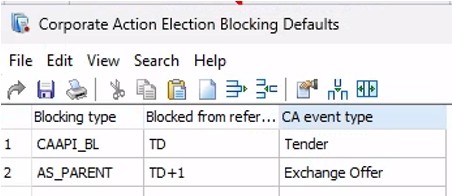
A new Corporate Action Elections Blocking Defaults window has been introduced to let users define default parent-blocking rules for elective corporate action events. In this window, users can maintain a CA event type, Blocking type, and Blocked from reference date. The event type can be specified for event-specific rules, while a default row without an event type is used as fallback. These defaults are applied when elections are saved, so blocking information can be populated directly on the election instead of relying on blocking setup in CA static data.
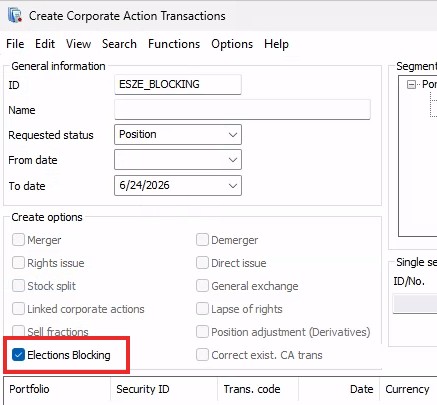
On the Create Corporate Action Transaction window, a new Elections Blocking option is available. When selected, the system generates parent blocking transactions based on the saved election blocking data. This allows blocking transactions to be created even when CA static data has not yet been created or transferred. The process is intended for elective events, where blocking must happen as soon as the election is made, and creates blocking transactions for the relevant elected holdings/options.
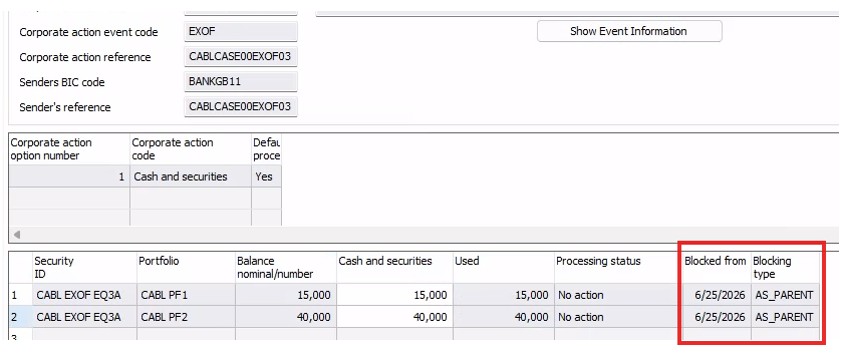
In the CAM Elections window, the blocking fields are now available directly on the election grid for supported events. Users can work with Blocking type, Blocked until, and the new Blocked from field. The fields show existing blocking information where blocking already exists, or allow blocking values to be applied and saved from the election flow. When relevant election or blocking values are changed, the system can delete existing election-based blocking transactions so that corrected transactions can be generated again.
Subscription-based licensing
Equity - Securities
Sales module dependency
Equities & Fixed Income
End-to-end improvements for TRS processing, including automated cancellation and enhanced import handling
This release introduces a comprehensive set of enhancements to improve the automation, accuracy, and robustness of Total Return Swap (TRS) corporate action processing for Single Name contracts.
A key capability introduced is the ability to cancel previously booked corporate action transactions directly through import files. Clients can now identify transactions using their own references and perform cancellations in a structured, automated way, with the option to rebook corrected transactions separately. This removes the need for manual intervention in Trade Manager and streamlines correction workflows.
In addition, the release introduces real termination transaction generation, aligning system behaviour with the true economic outcome of events such as full call, partial call, and final maturity.
Real termination processing includes:
- Direct generation from import files, using event-driven inputs
- Population of the corporate action event type on the transaction
- Accurate sizing using nominal/number of shares from the file
- Price and FX rate handling at termination, supporting single- and cross-currency TRS
- Validation to ensure eligibility (e.g., bond-underlying TRS only)
Beyond termination, the release strengthens the TRS import and processing framework through:
- Improved contract identification via security references
- Standardised transaction status assignment
- Enhanced XML mapping and validation controls
- Trade date support within cancellation workflows
Operational transparency is improved via clearer batch job validation messages aligned to XML tags, making issues easier to diagnose and resolve.
Benefits to Clients
- Enables true economic termination of TRS contracts, improving accuracy and reporting
- Provides automated cancellation and correction workflows, reducing manual effort
- Improves data accuracy through precise handling of nominal, price, and FX at termination
- Enhances traceability with event-linked transactions and external references
- Reduces operational risk and exceptions, especially for complex and backdated events
- Improves transparency and troubleshooting with clearer validation and logs
Subscription-based licensing
Corporate Actions Manager, TM Total Return Swap
Sales module dependency
Corporate Actions Manager, TM Total Return Swap
Rollover lifecycle event for TRS – Single Name equity Swap
As of release 26.07, the rollover with new trade id, lifecycle event has been added to the Equity Swap instrument.
Benefits
- As of release 26.07, you can book a rollover for a single name Total Return Swap (TRS) contract in SimCorp Dimension. You can close an existing TRS contract and open a new one with a different trade ID, while adjusting the notional amount, spread, and so on. This enhancement gives you greater control over contract renewals, terms, and balances. You can manage TRS contract lifecycles more easily and accurately.
- When you book a rollover, you close the old contract and open a new one. The new contract uses its own trade ID, balances, and terms. During the rollover, you can change the notional amount, spread, and so on. You can also specify a closing price for the old contract, and an opening price for the new contract.
- SimCorp Dimension calculates the profit and loss (P/L) for the closed contracts. You can choose not to trigger payment on the TRS close transaction by selecting the Do not trigger payment on TRS close transaction check box. If you select this check box, the old contract stays open to ensure that income can be received and reset after the rollover. Otherwise, the close leg of the rollover can include a cash amount. This functionality is only available for a single-name TRS with an underlying equity.
Subscription-based licensing
TM Total Return Swap
Sales module dependency
Alternative Investments Manager, Cash-flow TM Total Return Swap
General reconciliation enhancements
Reconciliation Manager supports reconciliation actions directly on grouped rows in the Results Monitor. When results are grouped, users can select one or more valid group rows and apply supported actions to the underlying reconciliation results in each group, instead of expanding the group and selecting individual result rows manually.
Supported group-level actions include matching and unmatching, adding free comments, assigning results to a user, and updating multiple classification fields at once via the Deviation Details applet. Payment and cash-related actions are also supported, including interim suspense payments, partial pay, and force close.
This makes high-volume reconciliation work faster and easier, especially when users already work with grouped views (e.g., group by matching index) to analyse exceptions. Actions are only enabled when the records from the groups are valid for the action, helping users apply bulk updates safely while keeping the existing Results Monitor workflow.
- Reduces manual effort by allowing actions on grouped reconciliation results.
- Improves efficiency when handling large volumes of exceptions.
- Keeps the familiar Results Monitor grouping workflow.
- Applies actions per selected group, preserving existing validation rules.
Subscription-based licensing
IBOR Manager And Investment Operations API
Sales module dependency
Reconciliation Manager
Release 26.04

OTC – CDS Index option in Trade Manager
The CDS index option is now available in Trade Manager, featuring a Trade Manager-based Index CDS as its underlying instrument. This option uses an EU style exercise, meaning it can only be exercised at expiration, and physical delivery, which requires that the underlying CDS contract is delivered to the holder when the option is exercised. These mechanisms provide clarity and standardization for transaction settlement.
The CDS index option supports both cleared and bilateral transaction flows, along with all related lifecycle transactions, making it flexible for different trading environments.
Strike price can be defined as either a spread or a price, and the underlying index CDS is specified using the recently introduced CDS Standard Product functionality (effective from 07/25).
Theoretical pricing of the CDS index option is fully supported through the OneLib and FINCAD pricing libraries. OneLib and FINCAD are specialized software tools that perform complex calculations to estimate the fair value of financial instruments, helping users assess option pricing and risk.
As of the 26.04 release, the “Done deal” flow is fully supported, allowing users to efficiently finalize transactions. Please note that order flow integration will be available in a future release, ensuring a seamless experience for managing orders once this functionality is introduced.
Benefits
- The CDS index option is a new instrument type in Trade Manager, fully integrated into both cleared and bilateral lifecycle flows. Exercising this option results in the creation of a Trade Manager-based index CDS, streamlining the process for users.
- This option is fully aligned with clearing house protocols. A risk manager can use the CDS index option to hedge credit volatility by purchasing the option and then exercising it to obtain exposure to the underlying index CDS. This enables efficient management of credit risk and supports strategic migration of positions to optimize clearing and settlement.
Subscription-based licensing
TM CDS Index option
Sales module dependency
Credit - Credit Default Swaps and Swaptions
Automated Increase-based processing of selected TRS corporate actions via structured file import
It is now possible to automatically create Increase transactions for selected corporate action events on single-name Total Return Swaps (TRS) through the import of a structured file containing corporate action information (for example, XML-based files).
For supported event types such as Bonus Issue (BONU), Stock Split (SPLF), and Stock Dividend (DVSE), the system can generate an Increase transaction to reflect the nominal impact of the corporate action. These increased transactions can be created in Trade Manager with the transaction price automatically set to zero. This allows nominal adjustments resulting from corporate actions to be reflected while preserving the existing TRS contract, supporting better trade continuity and more operationally efficient processing.
The enhancement also introduces integration flexibility for corporate action event files. The import uses a hardcoded default mapping for supported structured file tags and optionally allows clients to apply an XSLT transformation to translate their own structured file formats into the expected format. This removes the need for a dedicated tag-mapping screen, reduces configuration effort, and simplifies support for client-specific file layouts. The import supports structured corporate action event files, allows multiple files to be processed from the configured import directory, and passes the resulting changes to Trade Manager for downstream handling.
Benefits
- Streamlines corporate action processing for TRS by enabling nominal adjustments to be handled through a dedicated Increase transaction, reducing operational complexity for supported event types
- Preserves trade continuity by keeping the original TRS contract intact, helping firms maintain clearer trade histories and simpler lifecycle management
- Improves integration flexibility by supporting structured corporate action event files and allowing client-specific formats to be translated using XSLT where needed
- Supports scalable growth by establishing a robust and extensible foundation for future enhancements to TRS corporate action processing and import capabilities
- Improves valuation accuracy by ensuring nominal adjustments are applied at a zero price, allowing the next reset to fully and correctly recalculate the contract value
This image highlights an Increase transaction booked at a zero price, automatically generated from corporate action information and clearly marked with the corporate action event indicator.
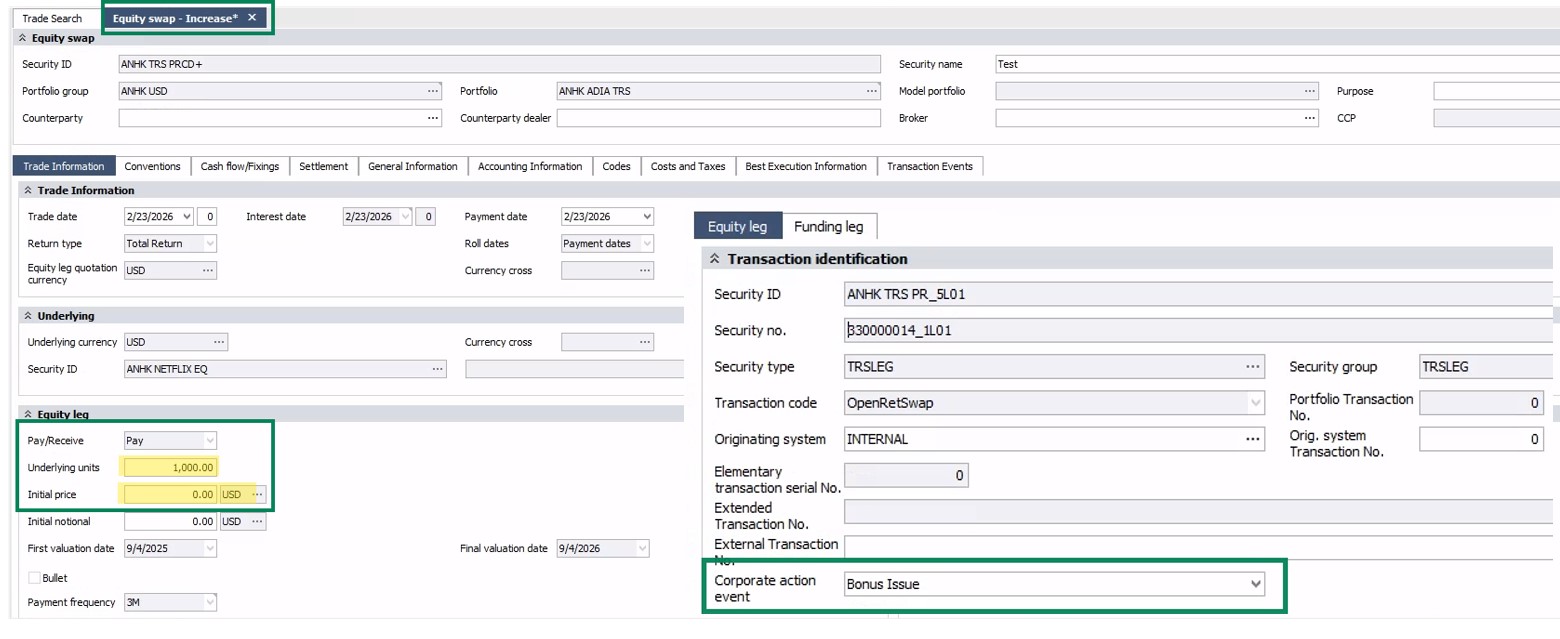
Caption: Zero priced CA Increase transaction with corporate action indicator
Subscription-based licensing
Corporate Actions Manager, TM Total Return Swap
Sales module dependency
Corporate Actions Manager, TM Total Return Swap
Enabled TRS closure using Modify Position based on Number of units
As of release 26.04, the following new fields have been added to the Modify position option in Asset Manager:
- Existing number of underlying
- You can modify Number of underlying, but can only view Existing number of underlying.
These fields enable you to use the Modify position option in Asset Manager to partially close Total Return Swap (TRS) positions based on the number of Underlying units rather than the Initial notional number. In addition, the Balance number of underlying field has been added to the Simulations applet. - Over the lifetime of a TRS contract, the initial notional can change because of periodic resets, which enables a portfolio manager to think more in terms of the underlying. The Number of underlying field can also be modified in the Simulations applet in Asset Manager.
- The Underlying units field in the Trade Manager equates to the Number of underlying field in Asset Manager. This is valid for:
- You can modify Number of underlying, but can only view Existing number of underlying.
- Instrument sub-type — Bond swap, Equity swap, Index swap
- Transaction type — Close
Benefits
- Enables users to close a TRS based on number of units rather than notional amount
Subscription-based licensing
TM Total Return Swap
Sales module dependency
TM Total Return Swap
Added Status Tab to TRS basket
As of release 26.04, you can view the basket composition information for TRS baskets in the Trade Manager. This enhancement provides transparency in how resets and basket adjustments affect basket valuations during lifecycle management of TRS baskets.
The new Basket Status sub-tab displays a snapshot view of basket composition on the date specified in the As of date field. The Basket Status sub-tab shows the following information for a TRS basket on a specific date:
- The Last reset date field displays the most recent reset date for reference. The corresponding Basket value QC field displays the aggregated value of all basket constituents at that time. These fields are auto-populated and cannot be modified.
- You can view the basket composition based on adjustments that are applied sequentially by dates, on top of the last reset or initial basket (whichever is applicable).
- You can also view the averaged prices and FX rates derived from the reset date and any adjustments that follow in the basket status information grid.
To view the latest TRS basket status, go to the Basket Status sub-tab in the Basket Information section under the Trade Information tab. Alternatively, you can also view the Basket Status sub-tab under the new Basket Information tab. In the As of date field, you can enter the date for which the basket status must be displayed. The basket status information grid displays the valuation inputs and adjustments applicable to that specific date.
The values in the basket status information grid do not appear in other pricing or grids but enable you to validate expected performance after adjustments.
Benefits
Enables users to view an update or past view of the current basket constituents on a TRS bond basket or equity basket
Subscription-based licensing
TM Total Return Swap
Sales module dependency
TM Total Return Swap
Bulk processing added to OTC web API
New endpoints have been added to the OTC web API, designed to handle large volumes of incoming contracts. These endpoints accept any mix of either transactions or order, and will then process these in the most optimal way. Significant performance improvements have been observed for this approach. Furthermore, resiliency mechanisms have been implemented for these endpoints, so that in case of an outage they can resume execution at the appropriate point, without manual intervention.
Benefits
- Significant performance improvement, especially at large volumes
- Resiliency mechanisms have been built in, to reduce operational risk
Subscription-based licensing
OTC web API
Sales module dependency
Trade Manager
Added four more classification-like fields with value-level authorizations and bulk update.
Reconciliation Manager now supports four additional controlled classification fields (Classification 2–5) alongside the existing Classification. This makes it easier to tag and organise reconciliation results using pre-defined, consistent values instead of relying on free text.
The new classification fields are available in Reconciliation Manager screens (Results Monitor and dashboards) and support fast, bulk updates. You can enter values in the redesigned Deviation Details applet and apply them to multiple selected results in one go, with per-field control over whether existing values should be overridden or not. Reconciliation free code 5 (of type: Date) and Free Comment can now be updated in bulk as well.
Classification lists can be maintained per reconciliation setup, so different teams can work with the terminology that fits their process and reconciliation type.
Importantly, the solution has two levels of authorisation support:
- users can be restricted from updating fields by removing access to the field itself
- specific classification values can be made read only for unauthorised profiles
This enables more governed operational workflows — for example, using controlled classifications as part of break approval or escalation flows — while keeping automation possible via extended Auto-fill rules and rollover support.
Each classification field comes with three related values: ID (the editable field), plus Name and Description — enabling more meaningful, longer text to be displayed in the Results Monitor and used for reporting.
Benefits
- improving transparency, data quality and consistency
- faster break processing via bulk operations
- improved governance and control through authorisations
Subscription-based licensing
Reconciliation Manager
Sales module dependency
IBOR Manager
Release 26.01
Spread option enhancements
As of version 26.01, the Spread option, OTC instrument supports forward premium payments and barrier conditions on the underlying assets in the Trade Manager.
With the forward premium payment enablement, the user can define when the premium is paid (spot or forward). With this enhancement, you can select whether the premium is paid upfront (spot) or at maturity (forward).
Optionally, you can also define the barrier levels for each underlying asset to control when the option becomes active. To support rate contingency, two optional fields—Upper barrier and Lower barrier—have been added for each underlying asset. These fields define thresholds that determine whether the option becomes active and generates a payoff.
The pricing correlation setup is now optional and only required if you specify a contract-specific pricing model. If you price the spread option without this model, you do not need to specify pricing correlation.
Benefits
- Enables users to book a Spread Option transaction according to market standards
- Enables users to handle more exotic Spread Option variants with conditional payoffs
Subscription-based licensing
TM Spread Option
Sales module dependency
TM Spread Option
Handling caps/floors on daily fixings
As of version 26.01, you can apply caps and floors to daily reference rate fixings on overnight index swaps (OIS) for Flexi Formula Swap XpressInstruments.
Benefits
- Enables the user to apply a cap or a floor on the individual daily fixing rate, like SOFR/SONIA, when calculating the daily compounded rate
Subscription-based licensing
XpressInstruments custom
Sales module dependency
N/A
Interest rate swaps – Support trading on NPV
As of version 26.01 it is possible to trade Interest Rate Swaps (deliverable and non deliverable currencies) based on agreed net present value. SimCorp Dimension will then do the backward calculation of accrued interest on the two legs and place the residual as an upfront amount on the chosen leg (Default is to place the Residual on leg 1, which is the fixed leg for the supported types).
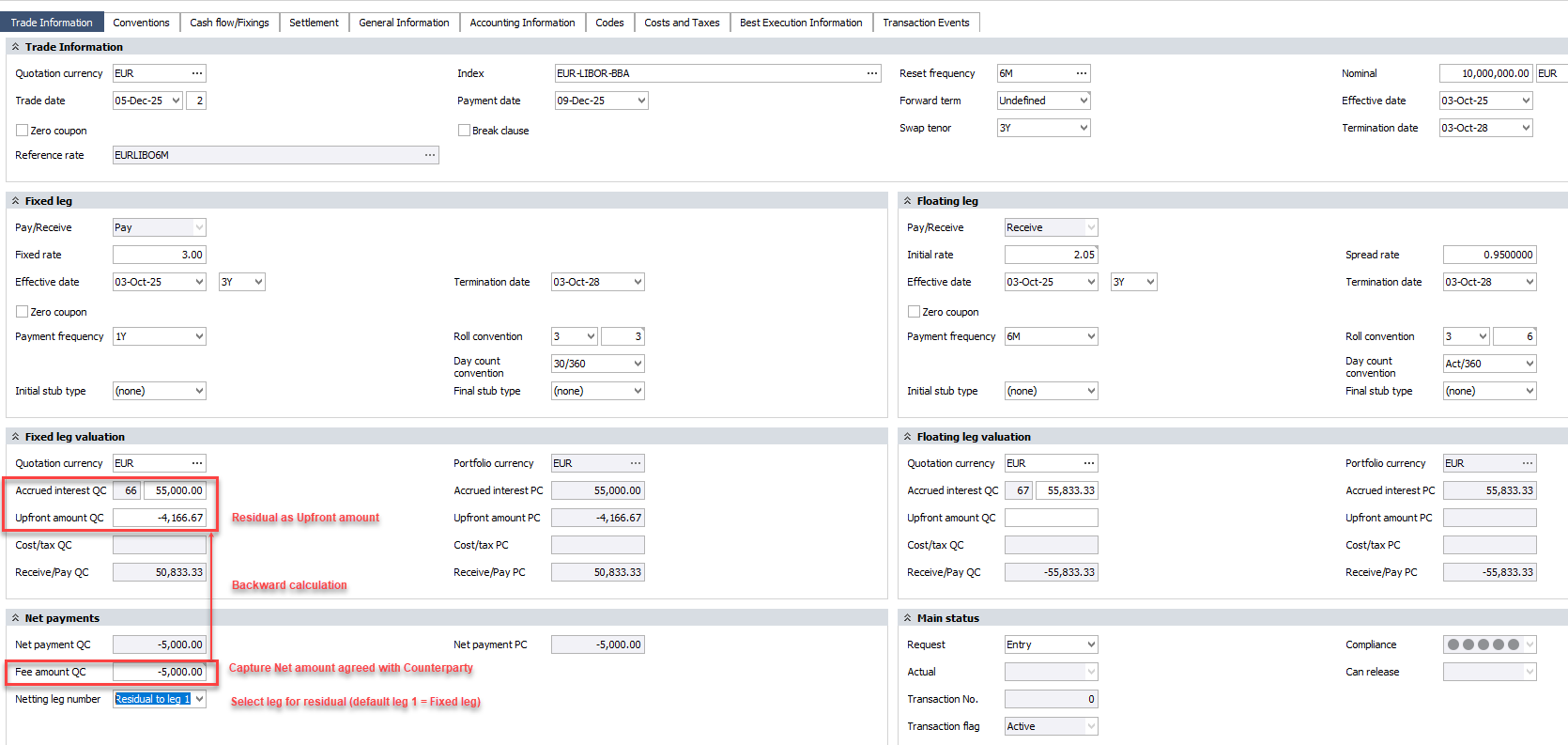
This new feature is especially relevant when doing offset trades and post trade events for bilateral swaps and it is the Standard used by most Trading platforms. The new feature is available for
Swap types:
- IR swap, fixed/float
- IR swap, OIS
- Non-deliverable IR swap fixed/float
Event types: - Close (existing)
- open new
- Increase existing
- Offset close
- Increase new
- Novate
Benefits
- Align with market standards when executing offset trades and performing post trade events
Subscription-based licensing
Interest Rate – Swaps and Swaptions
Sales module dependency
Fixed/Float Interest Rate Swaps,
Asset swaps and Non-deliverable swaps
CDS Index – New features for CDS Index Standard products
A group of new features Related to CDS Index has been introduced with 26.01.
The first new feature is the possibility to define standard settlement days for transactions based on standard products (typically 1 day for Cleared CDS Index Trades and 3 days for bilateral). The standard settlement days can be maintained in the convention tab for CDS Index Standard products.
The second feature introduced with 26.01 is the possibility to do netting across existing positions using the “old” CDS Index concept and positions using the “new” CDS Index Standard product concept. The result will be a position in the Standard Product. This feature makes it possible to make a smooth and easy transition of existing CDS Index positions (based on the “old” concept”) to the new CDS Index Standard Product concept without need for a “big bang” or conversion of existing data.
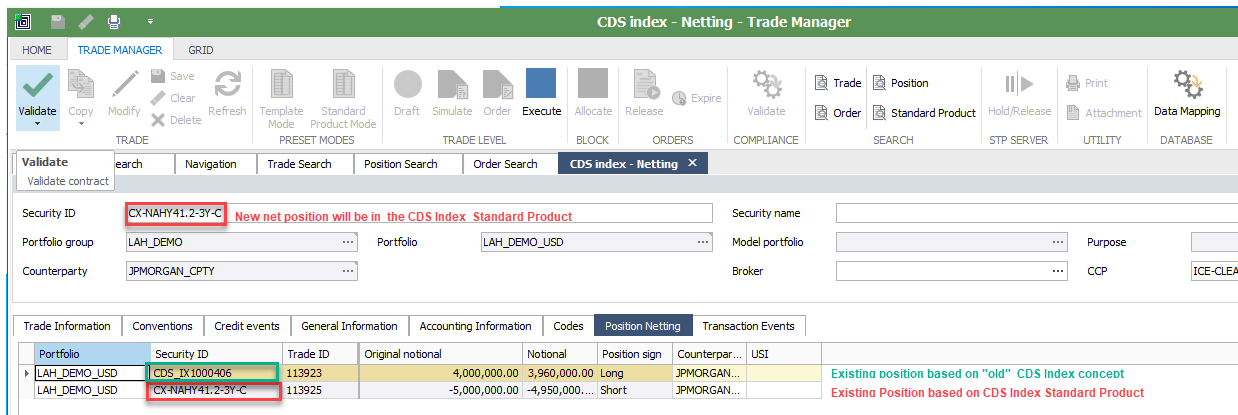
Benefits
- Smooth transition from the “old” CDS Index concept to the “new” concept based on Standard Products
Subscription-based licensing
Credit – Credit default Swaps and Swaptions
Sales module dependency
CDS Index as a standard product
Valuation of Mid Curve Swaptions and CMS Spread Options
You can now perform advanced valuation and risk analysis for complex interest rate derivatives using two new pricing models:
- Gaussian-Copula Model with Normal SABR for CMS Spread Options
Enables accurate pricing and sensitivity analysis for CMS spread options, incorporating swap rate correlations and volatility surfaces.
- Bachelier Model for Mid-Curve Swaptions
Supports valuation of mid-curve swaptions and is captured in Trade Manager, providing robust analytics under normal volatility assumptions.
Instrument Scope
- TM Spread Option, OTC, with underlying CMS rate
- TM Swaptions, Fixed/Float and OIS, with Forward term
Benefits
Comprehensive Risk Metrics
Calculate prices, sensitivities, and Greeks including:
- Delta, Gamma, Vega, Theta
- DV01, OAS
- Dirty price, Clean price
- Correlation sensitivity (Rho)
Improved Accuracy for Complex Structures
Advanced models (Gaussian-Copula + SABR, Bachelier) allow calibration to market prices and precise valuation of instruments sensitive to correlation and volatility shifts.
Scenario Analysis and Portfolio Impact
Incorporate market data scenarios for portfolio-level calculations, improving decision-making under different market conditions.
Streamlined Workflow
Direct integration with Trade Manager and Volatility Curve Definitions ensures smooth setup:
- CMS Spread Options: Configure underlying reference rate, par yield convention, and single-look payment structure.
- Mid-Curve Swaptions: Capture trades with correct reset frequency and ATM moneyness.
Transparency and Troubleshooting
Use Calculation Trace and Explain Calculation for detailed diagnostics during valuation.
Why This Is Valuable
These enhancements empower users to:
- Confidently price and manage risk for CMS spread options and mid-curve swaptions.
- Meet regulatory and internal risk management requirements with accurate Greeks and correlation sensitivities.
- Reduce operational complexity by leveraging integrated workflows and standardized data sources.
Subscription-based licensing
Interest Rate - OTC Derivatives,
Interest Rate – Swaps and Swaptions
Sales module dependency
No dependency
Valuation of Convertible Bonds with Ayache-Forsyth-Vetzal model
You can now use Ayache-Forsyth-Vetzal (AFV) model for pricing convertible bonds. This enhancement enables accurate valuation and risk analysis for convertible bonds using advanced numerical methods, supporting both theoretical pricing and calibration to market price.
- Convertible bonds with underlying instruments:
- Equity
- Fund certificate
- GDR/ADR
Benefits
- Comprehensive Analytics for Convertible Bonds
- Calculate a wide range of key ratios and risk measures.
- Credit Spread Handling
- The AFV model uses the spread yield curve for credit spread specification, ensuring more accurate discounting and calibration.
- Dividend Projection Support
- For convertible bonds with equity underlyings, valuations incorporate time-series dividend projections.
- Calibration to Market Prices
- The Quoted price + yield curve method supports calibration by calculating OAS, enabling alignment with observed market prices.
- Integrated Workflow and Transparency
- Updated Explain Calculation report reflects AFV model enhancements, and Calculation Trace supports troubleshooting.
Why This Is Valuable
These enhancements empower users to:
- Accurately price and manage risk for convertible bonds in portfolios.
- Incorporate realistic dividend projections and credit spreads for better valuation precision.
- Meet compliance and reporting requirements with full transparency and detailed analytics.
- Streamline workflows by leveraging integrated pricing definitions and volatility curve settings.
Subscription-based licensing
Foundations
Sales module dependency
No dependency
Release 25.10
Index fixing for swaps in Trade Manager
As of version 25.10, users of TRS in the trade manager can add their own “customer” business centers in addition to the standard business centers maintained by Simcorp. Users can add the new business centers via the new business center form and will be able to link them business center calendars in the same way as the previous standard centers.
These new “customer” business centers will be shown with the business center owner as “customer” and will only be selectable on the following instruments:
- Index Swaps
- Bond Swaps
- Equity Swap
- Bond swap, baskets
- Equity Swap, baskets
This enhancement will allow users to define business centers that are not in the current FpML list such as exchange business centers. This will enhance the flexibility of those instruments where they are permitted.
Subscription based licensing
TM Total Return Swap
Sales module dependency
TM Total Return Swap
Enhancements for exotic FX options in Trade Manager
As of version 25.10, the Trade Manager introduces enhancements for exotic FX options, with a focus on improving lifecycle handling, transparency, and alignment with market standards. These enhancements support correct modelling of barrier options, rebate handling, and valuation logic across the following exotic FX options:
- FX Option, Double Barrier
- FX Option, Single Barrier
- FX Option, Touch
Benefits
- Barrier window configuration—For FX Option, Single Barrier, FX Option, Double Barrier, and FX Option, Touch instruments, you can define a custom barrier observation period. You can do so by using the new Barrier window start and Barrier window end fields. This barrier observation period is independent of the effective dates and expiry dates applicable for the option but must remain within the effective expiry range.You can start the barrier observation period on the same day as the option's effective date, in line with market standards.
- Barrier window type—For FX Option, Single Barrier and FX Option, Double Barrier instruments, you can specify the barrier window type as either American or European in the new Barrier window type field.
- Rebate handling—For FX Option, Single Barrier and FX Option, Double Barrier instruments, the new Rebate field is available. SimCorp Dimension supports rebate amounts and automatically processes them for knock-in and knock-out scenarios where the option remains, or becomes inactive. Rebate payments are generated on expiry and are handled as separate payments, with no link to forward premium.
- Barrier description—For FX Option, Single Barrier and FX Option, Double Barrier instruments, a second option is available next to the Barrier type field. This second option reflects combinations of option types and barrier types applicable to the FX option.
- Support for knock-in/knock-out barrier combinations—For FX Option, Double Barrier, you can configure barrier type combinations such as knock-in-knock-out scenarios.
- Monitored values—For FX Option, Single Barrier, FX Option, Double Barrier, and FX Option, Touch instruments, the new BARRIER_HIT and OPTION_ACTIVE monitored values are available. These values help you track whether a barrier has been breached and whether the option is currently active. These values can be retrieved by using relevant formula functions. You can also use the new getximmonitored() formula function that retrieves monitored values from XpressInstruments—specifically for use in transaction-level and position-level contexts.
Subscription based licensing
TM Total Return Swap
Sales module dependency
TM Total Return Swap
Enhancements to TRS business centres in Trade Manager
As of version 25.10, users of TRS in the trade manager can add their own “customer” business centers in addition to the standard business centers maintained by Simcorp. Users can add the new business centers via the new business center form and will be able to link them business center calendars in the same way as the previous standard centers.
These new “customer” business centers will be shown with the business center owner as “customer” and will only be selectable on the following instruments:
- Index Swaps
- Bond Swaps
- Equity Swap
- Bond swap, baskets
- Equity Swap, baskets
This enhancement will allow users to define business centers that are not in the current FpML list such as exchange business centers. This will enhance the flexibility of those instruments where they are permitted.
Subscription based licensing
TM Total Return Swap
Sales module dependency
TM Total Return Swap
Release 25.07 IBOR
CDS Index - Support of hard credit events
A new Event type, Credit Event, has been introduced for CDS Index to improve the handling of hard credit events (e.g., bankruptcy, failure to pay). The new event type combines the settlement of the credit event with the re-versioning of the continuing CDS Index position to the new index version.
The new Event type is available for CDS Index:
- In the Trade Manager Position search for manual processing of credit events.
- As a new option in Create Credit Derivatives Transactions supporting an automated flow.
The new event type is a two-legged transaction where:
- The first leg contains information about the old version of the Index and the settlement of the Credit Event.
- The second leg contains information about the continuing position in the new index version.
A feature of the new event type is, that it supports different views on the re-versioning in front office and back office.
- In front office, the re-versioning will take place the day after the auction date, when trading in the new index version will start.
- The back office view will align with the Trade Information warehouse and the clearing house, keeping positions in the old version open until the auction settlement date, when the re-versioning takes place.
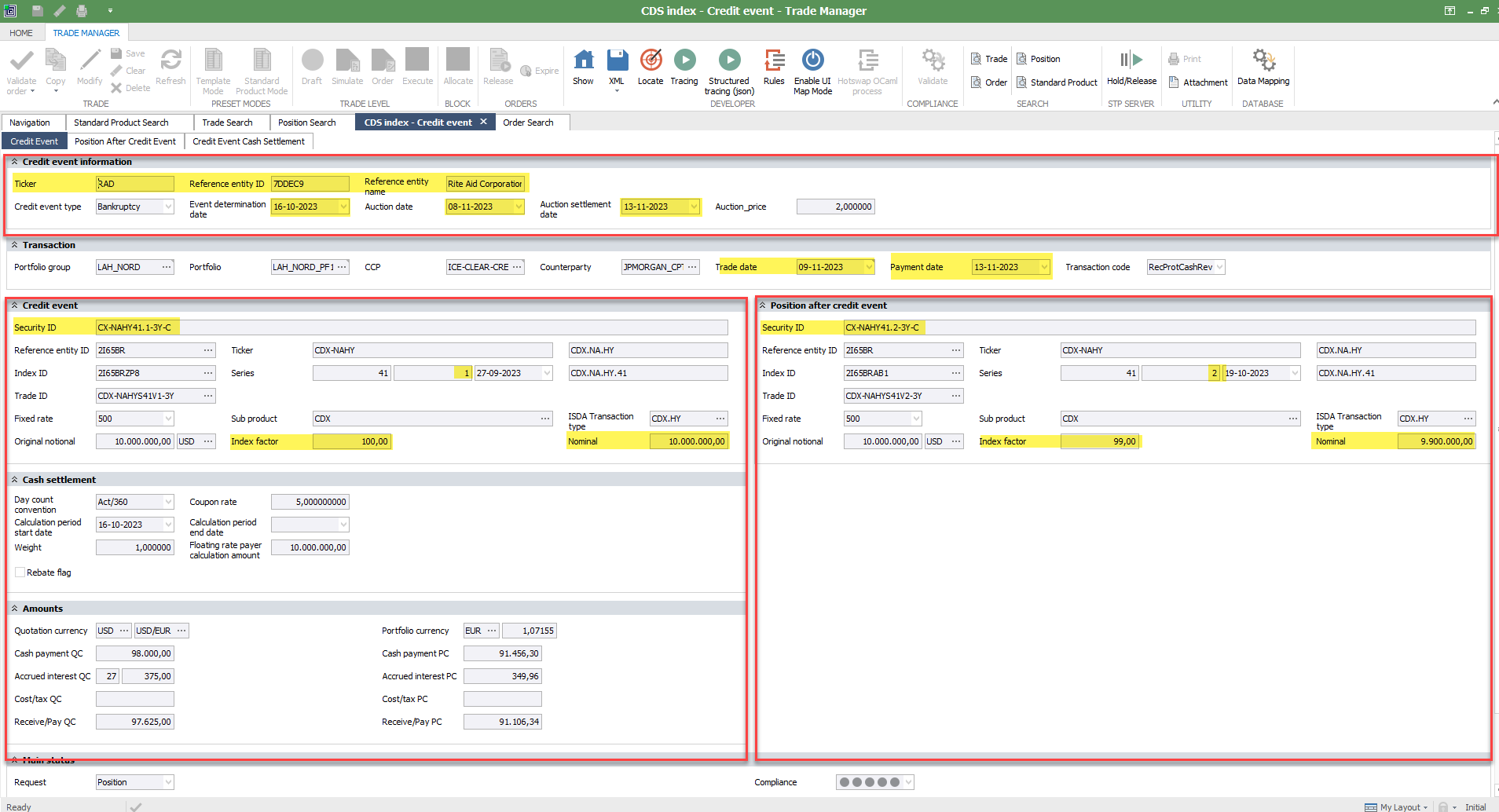
New Credit Event transaction type in the Trade Manager.
The new Credit Event transaction contains 3 tabs:
- Credit event tab showing an overview of the credit event, the position before and after the credit event, including settlement information.
- Position After Credit Event tab containing detailed information about the position continuing after the credit event.
- Credit Event Settlement tab containing detailed information about the position before the credit event and its settlement.
The overview tab (see above) is divided into 4 sections:
- First section contains information about the credit event, including defaulting entity, auction date, price, and auction settlement date. This information is generated based on Credit Event data and can’t be changed.
- Second section contains affected portfolio, other position identifiers, and main transaction data such as transaction type and trade and payment date.
- Third section contains information about the position before the Credit Event (based on standard product) and the settlement information of the Credit Event.
- The fourth section contains information about the continuing position in the new standard product representing the new index version and adjusted nominal.
On a credit event transaction, SimCorp Dimension calculates P/L values based on the notional portion of the CDS position corresponding to reference entities in the index version that have experienced a hard credit event.
Thus, in the P/L sub-window, on the out leg, you can view:
- P/L values calculated for the defaulted parts only.
- Cost value, book value, and up front-related balances relevant to the entire position.
Balances proportional to nominal outstanding are reallocated and booked to the new CDS index version position.
As a result of a credit event, positions in the old CDS index version are fully closed, and a position in the new CDS index version is opened.
Please note:
- A prerequisite for using the new Credit Event type is the use of CDS Index Standard Products. Standard product for the new version must be created in advance.
- The use of the new event type requires the use of the upfront approach for CDS Index Trades.
- You are recommended to use the Up-front in book value - advanced multiple trades swap payments setting option in the FAM window, even though SimCorp Dimension supports all applicable CDS Index Swap payment options in relation to CDS indices standard product accounting.
- UTI/USI will remain the same for the position in the new index version
Benefits
- Optimized credit event handling by combining settlement of the credit event and re-versioning of the continuing position into one new event type.
- Improved handling of positions seen in front office. Positions will be shown in the new version the day after the auction date.
- Improved handling of positions seen in back office. Positions will be shown in the old version until the auction settlement date (where the re-versioning also takes place in the DTTC trade Information warehouse and at the Clearing House).
- Improved accounting handling with transfer of values from the old to the new version.
Subscription based licensing
Credit-Credit Default Swaps and Swaptions
Sales module dependency
CDS Index as a standard product
CDS Index
Trade Manager
Enhanced notional reset handling and cash flow calculations for total return swaps in the Trade Manager
Nominal changes, notional resets, and cash flow calculations of total return swaps will be reflected more accurately in the Trade Manager
As of version 25.07, nominal changes, notional resets, and cash flow calculations of total return swaps will be reflected more accurately in the Trade Manager TRS instruments:
Instrument scope:
- Bond swap
- Bond swap, basket
- Equity swap
- Equity swap, basket
- Index swap
Note: This feature is not applicable to TRS basket contracts with adjustment transactions.
Key benefits
- Accurate cash flow information—Factoring in the new notional on existing reset transactions resolves previous discrepancies in the cash flow information of the funding leg for open and lifecycle transactions. Notional changes between resets, occurring due to any lifecycle transaction, are considered to ensure correct nominals on both performance and funding legs.
- Enhanced view of reset transactions—The Resets tab displays detailed information for both performance and funding legs, including notional changes and performance amounts. This offers a more integrated and transparent overview. A mouse-over tooltip on the Notional field in the grid highlights the impact of reset transactions affected by lifecycle transactions.
- Enhanced view of lifecycle transactions—You can also view the details of all lifecycle transactions associated with a TRS trade in the added Lifecycle Transactions tab under the Cash flow/Fixings tab in the Trade Manager. You can monitor the notional changes and performance amounts for lifecycle transactions created in the Trade Manager. This enhancement streamlines the TRS workflow by offering comprehensive insights into the trade.
Subscription based licensing
TM Total Return Swap
Sales module dependency
TM Total Return Swap
Removed limitation on number of business centers for total return swaps
The Trade Manager previously had a limitation of the number of business centres on a TRS instrument and this has now been removed
As of version 25.07, you can select any number of business centres for the following TRS instruments in the Trade Manager:
- Bond swap
- Bond swap, basket
- Equity swap
- Equity swap, basket
- Index swap
This feature is only applicable to payment dates, valuation dates, reset dates, and FX conventions for TRS instruments.
Benefits
- Users can enter any number of business centres in TRS instruments now.
Subscription based licensing
TM Total Return Swap
Sales module dependency
TM Total Return Swap
Added Expiry Time and Expiry Time zone to FX Options in Trade Manager
As of version 25.07, you can add settlement information for a new FX option trade in the Trade Manager. Two fields, Expiry time and Expiry time zone, have been added for the following FX option instruments in the Trade Manager:
- FX Option
- FX Option, Digital
- FX Option, Double Barrier
- FX Option, Single Barrier
- FX Option, Touch
- The Expiry time field contains the latest time (in hh:mm format) and the Expiry time zone field contains the applicable time zone when the option can be exercised.
- Both fields are optional and available for data import.
- Neither field can be modified during the lifecycle of the trade.
- To enter these details for an FX option trade in the Trade Manager:
- Go to the Trade Information section on the Trade Information tab of the contract.
Set the latest possible time to exercise the option as Expiry time and select the Expiry time zone to the applicable time zone.
Subscription based licensing
N/A
Sales module dependency
Trade Manager
Include US Pools as underlying for TM Straight repos
Nominal changes, notional resets and cash flow calculations of total return swaps will be reflected more accurately in the Trade Manager
As of version 25.07, nominal changes, notional resets, and cash flow calculations of total return swaps will be reflected more accurately in the Trade Manager TRS instruments:
Instrument scope:
- TM Repo (straight repo)
Key benefits
- Ability to select US Pool instrument as underlying instrument type.
- When selecting underlying Security ID only US Pool securities are selectable.
- Pool factors from the underlying US pool are taken into account, when calculating the settlement amount.
Subscription based licensing
TM Straight repo
Sales module dependency
TM Straight repo
Corporate Action Instruction Widget
Automatic linkage and display of MT565/MT567 status and reason
The new Instructions Widget offers a significant enhancement to Corporate Actions processing capability. It is designed to provide greater transparency and efficiency by offering a consolidated, real-time view of MT567 status messages linked to each MT565 corporate action instruction.
This widget automatically links incoming MT567 messages to the corresponding MT565 event and displays the latest MT567 status code (e.g., PACK, PEND, CANC) along with the associated reason code. This enables users to immediately understand the current position of their instruction. Where multiple active MT567 messages exist for a single MT565, the widget shows the total count and displays the latest.
In addition, users can:
- View the full MT565 and MT567 message content directly from widget by right clicking on the widget item.
- See the full narrative text associated with the reason code, offering additional context for rejected or pending instructions.
- View the distinct status types (e.g., Instruction status, Processing status, Cancellation status) all in one place.
This enhancement allows users to work more efficiently, reducing the need to search across multiple windows.
Benefits
- Instantly view the latest status of MT565/MT567 messages without switching screens.
- Helps operations teams identify and resolve issues early, reducing downstream risk and ensuring timely, accurate processing.
- Minimizes the risk of settlement failures, missed entitlements, and instruction rejections or cancellations.
- Eliminates the need for manual reconciliation, freeing up valuable operational resources.

This image shows the MT567 Instruction Widget within the Corporate Action Dashboard, highlighting the status, reason, and narrative fields.
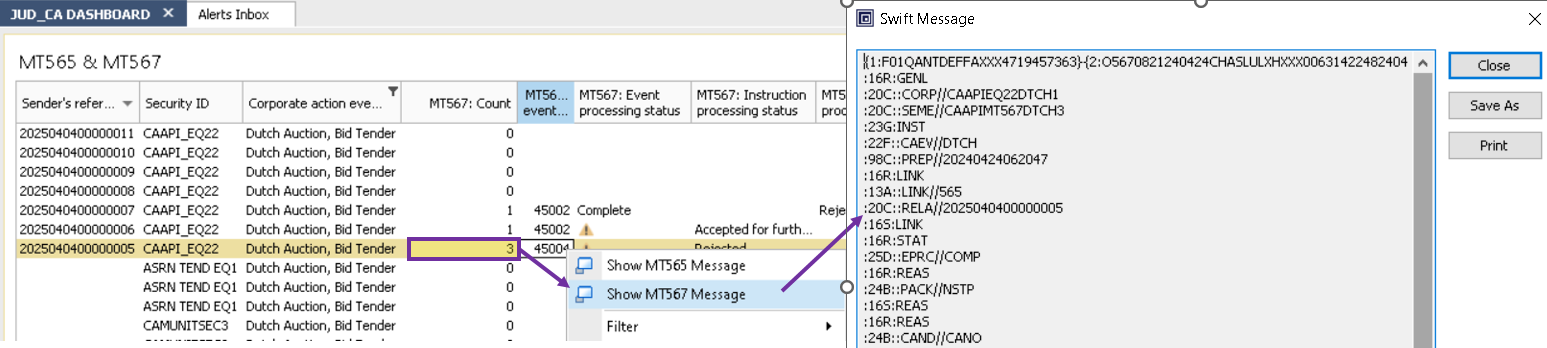
This image demonstrates the right-click functionality, revealing options to Show MT565 Message and Show MT567 Message for full message visibility.
Subscription based licensing
Equity - Securities
Sales module dependency
Equities
Ability to dynamically calculate tolerances during reconciliation based on rules
Tolerances in general reconciliation can now be specified in a more flexible way. Use predefined rules to dynamically determine and apply the appropriate tolerances based on the values of the internal reconciliation results. You can now, in a single reconciliation rule, specify different tolerances for various currencies, for example, 1 EUR for payments that settle in EUR and 10 YEN for payments in YEN. You can apply tolerances to all numeric reconciliation fields.
This setup also allows for entering a universal base tolerance in a base currency. Set a threshold for the reconciliation tolerances in a base currency, for example 1 USD, and get the threshold calculated automatically in different currencies, using the prespecified FX rates, and have those applied during reconciliation. The FX rates can be automatically updated via a batch job or manually as often as needed.
You can define the tolerance conditions in the Dynamic Tolerance Conditions window and use them in the Reconciliation rules.
Benefits
- More precision and consistency when reconciling.
- Define distinct tolerances per currency within a single rule .
- Manage tolerance logic with flexibility in one place (Dynamic Tolerance Conditions window).
Subscription based licensing
Reconciliation Manager
Sales module dependency
IBOR Manager
Release 25.04 IBOR
New batch job for updating OTC contract calendars
During the lifetime of an OTC contract, there may be changes to the definition of which days are non-banking days in the relevant business centers. A date that may have been a banking day when the contract was entered into, and so expected to have e.g. a swap payment, can turn out to be a non-banking day due to a new holiday.
With the new batch job ‘OTC Instruments– Validate All,’ such changes can be automatically detected and reflected on IRS and TRS contracts, correcting any days that are now non-banking days.
Benefits
- Automates the maintenance of banking days on IRS and TRS contracts.
Subscription based licensing
N/A
Sales module dependency
Trade Manager
Support for MXN OISs and MXN OIS swaptions with lunar calendars
As part of the industry-wide move away from LIBOR based benchmarks to alternative risk-free rates (“RFRs”) and following the announcements made by the Banco de México, as of 1 January 2025, new MXN swap contracts will be based on TIIE de Fondeo (an overnight rate), thereby replacing the existing 28-day Interbank Equilibrium Interest Rate in local currency (Tasa de Interés Interbancaria de Equilibrio, “28D-TIIE”).
This change will affect all MXN swaps with OIS legs. Therefore, Dimension now supports lunar calendars for the following Trade Manager swap instruments: IR swap, OIS, IR swap, OIS, basis, Cross currency, basis, Cross currency, fix/float, Non-deliverable IR swap, fix/float, Non-deliverable cross currency, fix/float.
These swap enhancements are available from 25.04 but have also been patched down to 24.10 and 25.01.
Secondly, from 25.04, Dimension now also supports handling lunar calendars for the Trade Manager instrument Swaption, IR swap, OI.S
Benefits
- The ability to handle MXN-based OTC contracts with lunar calendars
Subscription based licensing
N/A
Sales module dependency
Trade Manager
Support for NDS swaptions with physical delivery
Until 25.04, the existing Trade Manager instrument Swaption, Non-deliverable IR swap, fixed/float could only handle the settlement method Collateralized Cash Price”. The number of settlement methods has now increased, so Dimension now supports the following settlement methods: Physical, Cleared Physical, Cash Price and Collateralized Cash Price.
Secondly, we have also applied the Forward term to Swaption, Non-deliverable IR swap, fixed/float, allowing clients to handle forward-staring/mid-curve NDS swaptions.
Benefits
- Widen the scope and usability of the Trade Manager instrument Swaption, Non-deliverable IR swap, fixed/float.
Subscription based licensing
N/A
Sales module dependency
Trade Manager
Support for rounding on the Price QC field for Cross Currency TRS
We have added support to allow the ability to round the Price QC field on the Trade Manager to a defined decimal precision and rounding method.Additionally, this rounding on the Price QC field will continue throughout the lifecycle of the Total Return Swap.
Benefits
- Correctly support Cross Currency Total Return Swap rounding on the Price QC field for Index Swap, Bond Swap, and Equity Swap instruments.
Subscription based licensing
N/A
Sales module dependency
TM Total Return Swap
Support Forward Starting TRS with known Initial Price and Initial FX Rate
We have added support to allow users to define an Initial Price and an Initial FX Rate on a Forward Starting TRS. Previously, this was restricted and had to be created via valuation fixings/FX Fixings. Now, users can enter the initial price and/or initial FX Rate for a forward-starting TRS, and these will be picked up from Trade Manager in the initial exchange transaction.
Benefits
- Users can enter Price/FX Rate on a Forward Starting TRS from Trade Manager, and it will be used in the initial exchange without further action from the user.
Subscription based licensing
N/A
Sales module dependency
TM Total Return Swap
TRS – Portfolio Swap Agreement Tool
We have added support for a Portfolio Swap Agreement tool for Total Return Swaps. This allows users to define a Portfolio Swap Agreement in the newly created form in SCD. This reference can then be applied to multiple TRS trades using the portfolio swap agreement field in Trade Manager.
Benefits
- Users can link multiple Total Return Swaps in a synthetic wrapper within SCD.
Subscription based licensing
N/A
Sales module dependency
TM Total Return Swap
TRS – Increase lifecycle event available in Asset Manager Modify Position
We have added support for the Increase lifecycle event in the Modify Position functionality within Asset Manager. Previously, this was only available via Trade Manager.
Benefits
- Users can perform an Increase on a Total Return Swap using Asset Manager.
Subscription based licensing
N/A
Sales module dependency
TM Total Return Swap
TRS – Contract Simulation
Contract Simulations were not supported for Total Return Swap Baskets in Trade Manager and Asset Manager. This has now been added to enhance the overall functionality of the Equity Swap, Basket, and Bond Swap, Basket. We have also enhanced the single-name TRS contract simulation by adding the conventions tab, so that users can change defaults without accessing Trade Manager.
Benefits
- Users can perform a contract simulation for a Total Return Swap Basket in both Trade Manager and Asset Manager.
- Asset Manager users can now change default settings on TRS Single name without accessing Trade Manager.
Subscription based licensing
N/A
Sales module dependency
TM Total Return Swap
Release 25.01 IBOR
Price method “Quoted price and yield curve” can now use quoted price as input for FRAs
The price method quoted price + yield curve has been enhanced for FRAs to support changes in market quotations. Previously, FRAs were predominately quoted in yields, but more market vendors and clearing houses are now providing price information for FRAs in the form of of quoted prices.
With the quoted price + yield curves, it is now possible to use either a quoted yield or quoted price as input. As before, yield curve sensitivities are calculated regardless of the type of market quote used.
Benefits
- Supports the new type of market quoting for FRAs when using price method quoted price + yield curve to accommodate market standards.
- The same sensitivities are calculated, no matter which type of quote (yield or price) is used.
Subscription based licensing
Foundation
Sales module dependency
N/A
Audit trail for reconciliation execution actions and reconciliation results
Enhanced history log of manual changes
You can now access the full history of manual changes, even for results rolled over multiple days. In addition to displaying the manually changed fields, the new native fields Reconciliation Status and Free Comments provide an easy overview by displaying the latest value for each reconciliation day. All this is presented in a brand-new GUI, offering a more intuitive and user-friendly experience with customizable views, including filtering, grouping, or sorting.
Benefits
- Improved transparency to track and understand the evolution of the reconciliation results over time
- Better analysis and decision-making
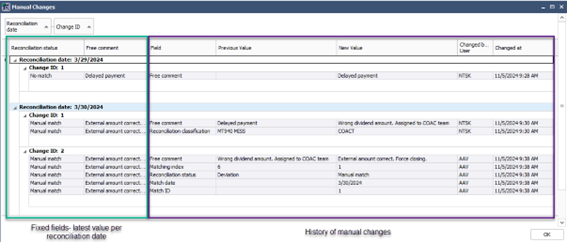
New GUI showing details about the changes from this record inception date
New audit trail for reconciliation execution actions
This version introduces an audit trail for actions performed at the reconciliation execution level. The log is accessible directly from the Reconciliation Manager.
For the following reconciliation actions, the log provides detailed information on when the action was started, any warnings or errors, when the action was completed, and by whom:
- Execute
- Partial re-execute
- Re-execute
- Internal import
- External import
- Apply auto-fill rules (only when applied manually or through a batch job)
- Re-open execution
- Close execution
- Sign-off execution
- Changes to the execution free comment (with the new comment visible in the Description)
Benefits
Improved transparency and accountability over the reconciliation process
Easier access to see errors or warnings that happen during execution or re-execution
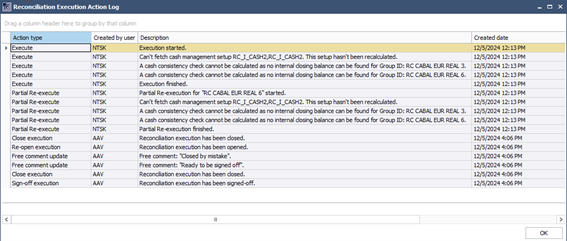
Actions log for a reconciliation execution
Subscription based licensing
IBOR Manager
Sales module dependency
Reconciliation Manager
Ability to use a holiday calendar for calculating date deviations
Date deviation can now be calculated using business days instead of calendar days. The holiday calendar used for calculating break age can now also be used to calculate date deviations.
Benefits
- Date calculations are more accurate and aligned with your business operations
- Increased matching rates and reduced manual effort for resolving false deviations
Subscription based licensing
IBOR Manager
Sales module dependency
Reconciliation Manager
Ability to apply auto-fill rules manually
Rules created in the auto-fill rules application can now be triggered manually, directly from the Reconciliation Manager, for both active and inactive rules. This complements the existing options of applying rules during execution (for active rules) or via a batch job (both active and inactive rules).
Moreover, the engine has been enhanced to also allow deactivation/reactivation of the reconciliation records, based on predetermined rules.
To applied rules, these actions are logged in the new reconciliation execution log.
Benefits
- Users can apply rules on an ad-hoc basis with just a few clicks
- Reduce tedious manual work and the risk of errors by setting up rules for automatic filling

Deactivated checkmark can be turned on or off based on rules

Pressing Apply auto-fill rules and choosing one or multiple auto-fill rules to apply
Subscription based licensing
IBOR Manager
Sales module dependency
Reconciliation Manager
Automatically process CFDs on position adjustment MAND Corporate Actions.
With the increasing complexity of financial markets and the growing demand for derivatives processing, automation has become a necessity. This enhancement empowers our clients to seamlessly manage Contract for Differences (CFDs) processing for the following mandatory position adjustment corporate actions events:
- Bonus issue
- Stock splits
- Reverse stock splits / Consolidations
Benefits
- Enables users to assess how a portfolio of funds will respond to future changes in market conditions and identify factors that could jeopardize the investment strategy’s success.
- Enables users to produce more robust forecasts, as stress scenarios can reflect a wider variation of possible futures and situations that may not have occurred in the past.
- Allows users to flexibly combine several types of cashflow-related stresses, such as accelerating capital calls, delaying repayments, and extending fund lifetimes, define the groups of funds to which these combined stresses can be applied.
Subscription based licensing
Corporate Actions Manager
Sales module dependency
Corporate Actions Manager, Equities
OTC Web API
We have launched the OTC web API, which allows for programmatic access to the OTC functionality in SimCorp Dimension. Orders and transactions on OTC contracts can now be created, changed, deleted, and updated. The API is integrated with the Front Office API, so that it is now possible to combine OTC and non-OTC orders in automated flows.
Benefits
- Enables automation of OTC workflows that were traditionally handled manually within the Trade Manager
- Enables easier integration with Front Office processing
- Enables export of OTC contracts to external systems
Subscription based licensing
OTC Web API
Sales module dependency
N/A
Create inflation curves from index bonds
In many developed markets, forward-looking inflation curves are best created from inflation derivatives, primarily from zero coupon inflation swaps (ZCIS). In other markets, such as Mexico and Brazil, where there is no liquid ZCIS market, the best alternative is to use index bonds. The former has long been possible in SimCorp Dimension’s Yield Curve Manager, and the latter is now also supported.
The inflation curve creation is enabled for all built-in index variants but is most relevant in practice for Mexican and Brazilian variants.
With the new functionality, you can create accurate inflation curves also in economies without a liquid ZCIS market. The accurate inflation curves lead to more consistent pricing and improved risk management of inflation-linked instruments.
Benefits
- Generate accurate valuation and risk analytics for inflation-linked instruments in Mexico and Brazil
- Full auditable transparency in curve generation via the ubiquitous Explain calculation functionality
- Automate inflation curve generation with scheduled jobs shared across all curve types
Subscription based licensing
N/A
Sales module dependency
N/A
Auto-fill reconciliation fields based on predefined rules
Define rules based on the existing reconciliation results to automatically populate other reconciliation fields such as Classification, Free Comment, Reconciliation Free Codes, or Assign to fields. You can configure these rules in the new Auto-fill rules applet within the Reconciliation Manager. The rules will apply automatically during the reconciliation execution or can be executed ad hoc using a batch job.
Benefits
- Reduce tedious manual work and the risk of errors
- Streamline your reconciliation processes so you can focus on critical tasks
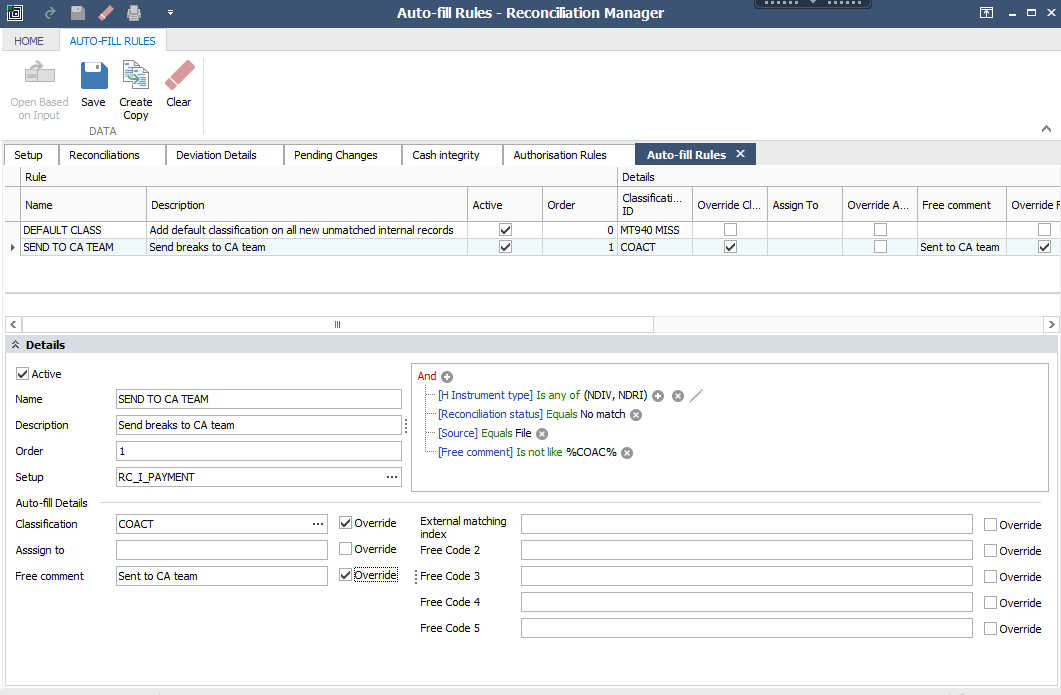
Multiple rules can be configured and executed in the specified order. In the image above, two rules will be applied during the execution: one rule adds a default classification to all new internal breaks, while the second rule sends external breaks on dividends to the COAC team by filling in the predefined classification value, COACT. This classification could also trigger an alert.
Subscription based licensing
IBOR Manager
Sales module dependency
Reconciliation Manager
More flexibility and a better control framework for one-side matching
You can now configure the one-side matching algorithm to apply exclusively to records from the external side, the internal side, or both sides. Previously, it would always apply to both sides.
Additionally, you can now set up authorization rules with the maximum possible granularity to control manual actions in the Reconciliation Manager and prevent human errors. Action types such as match, pay, force close, partial pay, etc., can now be combined with the type of record (internal or external) and the number of records (one-record or multiple).
These rules can now be highly customized depending on the specific action to be performed in the Reconciliation Manager.
Benefits
- Increased flexibility allows for better control over the matching process in the reconciliation application
- Enhanced security and risk of human errors by defining who can perform specific manual actions in the Reconciliation Manager and under which conditions
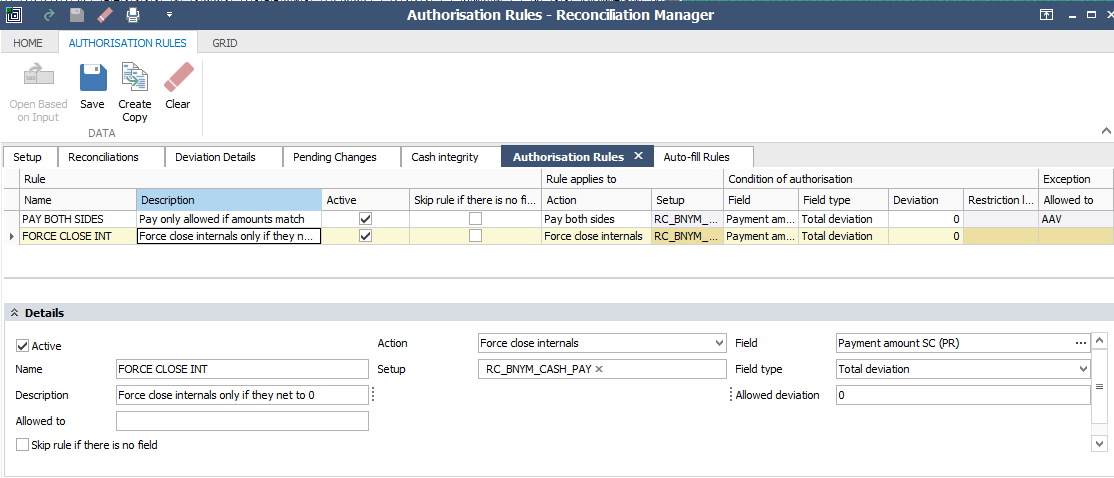
Define rules in the Authorization rules applet in Reconciliation Manager. The Total deviation field type has been enhanced to calculate the net amount for one-sided matching actions, while for both sides matching actions, it will check the difference between the amounts. Tolerances can also be set.
Subscription based licensing
IBOR Manager
Sales module dependency
Reconciliation Manager